
Food traceability: what the law requires and why manual records fail
Automation · Food traceability
Food traceability is the ability to trace and follow a food, feed or ingredient through all stages of production, processing and distribution. That is how Regulation (EC) 178/2002 defines it, and its Article 18 makes it mandatory for every food and feed business: it must be able to identify who supplied each raw material and which businesses it has supplied its products to, and provide that information to the authorities on demand [1].
That part is covered by delivery notes. The hard part happens inside the factory, between the intake pit and the truck: there, a batch of raw material is split across silos, weighed, mixed and ends up in many product batches. If that stretch is recorded by hand, a recall becomes slow and broader than necessary. We have been doing industrial engineering since 1981 and have automated 45 agri-food factories; here we explain what the regulations require, where manual records fail and how the data is captured from the PLC.
The short version: general food law requires one step back and one step forward. What decides whether a recall affects one batch or a week of production is internal traceability, and that depends on the plant's records. The answer is to have the batch, the weighing and the time recorded by the machine that already knows them.
On this page
- What food traceability is and what a batch is
- What the law requires of a food or feed factory
- Why manual traceability records fail
- Diagnostic matrix: how much your traceability depends on paper
- How traceability is automated in the plant
- From sensor to ERP: where the data lives
- The mock recall
- How we do it at ER Ingeniería
- Frequently asked questions
- Sources
What food traceability is and what a batch is
The unit you work with is the batch, or lot. Directive 2011/91/EU defines a lot as “a batch of sales units of a foodstuff produced, manufactured or packaged under practically the same conditions”, and it is set by whoever produces, manufactures or packages it [2]. One batch per day is easy to record, but if a problem arises the whole day is recalled. The finer the batch, the more narrowly the recall is contained.
The traceability guide of the Spanish Agency for Food Safety and Nutrition (AESAN) distinguishes three stages: backward, internal or process, and forward [3]. The law does not treat them in the same way:
| Stage | Question it answers | What the regulations require | Data needed |
|---|---|---|---|
| Backward (suppliers) | Who supplied me with this raw material, and in which batch? | Mandatory: Art. 18(2) of Regulation 178/2002 [1]. Article 18 does not require the batch number to be recorded, although the Commission recommends doing so [4]; for food of animal origin it is required by Regulation 931/2011 [8] | Supplier, product, batch, quantity and date of receipt |
| Internal or process | Which product batches did that raw material batch end up in, and vice versa? | Article 18 does not expressly require it, although the European Commission notes that it allows “more targeted and accurate withdrawals” [4]. For feed, Regulation 183/2005 requires the manufacturing history of each batch to be traceable [5] | Silo or tank, production order, actual weighings, times, cleaning operations and sequences |
| Forward (customers) | Which customers has each product batch gone to? | Mandatory: Art. 18(3) of Regulation 178/2002 [1]. The batch, as for backward traceability: recommended [4], mandatory for food of animal origin [8] | Customer, product, batch, quantity and dispatch date |
What the law requires of a food or feed factory
Article 18 of Regulation (EC) 178/2002, applicable since 1 January 2005, requires traceability to be established “at all stages of production, processing and distribution”, suppliers and customers to be identified, “systems and procedures” to be in place to provide that information to the authorities, and products to be labelled or identified [1]. AESAN calls this the “one step back, one step forward” approach [6].
Article 19 explains what it is for. If a business considers that a food it has produced or distributed does not comply with the food safety requirements, it “shall immediately initiate procedures to withdraw” it from the market where the food is no longer under its control, and inform the authorities [1]. This is not a rare case: in 2025, the European Union's Alert and Cooperation Network, which includes the RASFF rapid alert system, exceeded 10,000 notifications (10,490), 11% more than in 2024, although not all of them end in a recall [7].
For food of animal origin, Implementing Regulation (EU) 931/2011 specifies the data for each consignment (description, quantity, who dispatches it and to whom, batch reference and date of dispatch) and adds that this information “shall be updated on a daily basis” and provided to the authority “without undue delay” [8]. A record completed at the end of the week does not comply.
The other half of the paperwork comes from Regulation (EC) 852/2004: its Article 5 requires procedures based on HACCP principles to be maintained and documents and records to be drawn up “to demonstrate the effective application” of the measures [9]. In feed mills, Regulation (EC) 183/2005 goes further: it requires records that allow “effective tracing from receipt to delivery” and tracing of the manufacturing history of each batch [5]. We cover it stage by stage in the article on feed mill automation.
Why manual traceability records fail
The pharmaceutical industry gave a name to what a good record has to meet. The data integrity guidance of the UK medicines regulator (MHRA) sums it up in the acronym ALCOA: attributable, legible, contemporaneous, original and accurate [10]. It was written for medicines, but it is useful for reviewing any production report. A manual record usually fails on two counts: it is not contemporaneous, because it is written after the work, and it is not original, because it goes from paper to a spreadsheet and from there to the ERP. The same guidance requires manual transcriptions to be verified by a second person or by a validated system [10].
In the plant, those failures happen in specific places:
| Point in the plant | How the manual record fails | What happens in a recall |
|---|---|---|
| Reception | The batch is copied from the delivery note or the bag, and in the GS1 standard a batch number can be up to 20 alphanumeric characters long [11] | The backward search does not find the batch, or finds a different one |
| Silos and tanks | A silo topped up before it is emptied holds two batches at once; the sheet keeps the last one | Nobody knows which batch went into each production run, so every possible one has to be recalled |
| Weighing and dosing | The formula quantity is written down instead of the actual weighing, or it is rounded | There is no way to prove how much of each batch the product contains |
| Times | They are written down at the end of the shift, using a clock that is not the PLC's | They cannot be cross-checked against the system's alarms and temperatures |
| Cleaning and product changeovers | “Cleaning done”, with no time, no production order and no name | There is no way to prove what was produced before and after, which is what matters if there is carry-over |
| Copies between media | The same data goes onto paper, into Excel and into the ERP | There are two versions of the same batch and someone has to decide which one is valid |
None of these failures is the operator's fault. Asking them to copy a batch code at every load, with the line running, builds the error into the process. That is why we work the other way round: first, what data the machine already knows; the person only provides what the machine does not know.
Diagnostic matrix: how much your traceability depends on paper
This table is for assessing a plant without any software: you fill it in by walking round the factory with the production manager and the quality manager.
| What is checked | High risk | Medium risk | Low risk |
|---|---|---|---|
| Raw material batch at reception | Copied by hand from the delivery note | Typed into a terminal, without validation | Read from a barcode or selected from a list |
| Batches inside each silo or tank | Nobody records it; it is worked out afterwards | The last batch to come in is recorded | The system knows which batches, and how much of each, are in every silo |
| Raw material consumption per production run | The theoretical formula is used | The weighing is entered by hand at closing | The scale or doser records it with its batch |
| Cleaning and sequences | Box ticked on a sheet | Record with a time, not linked to the production run | Event recorded between two production orders |
| Dispatch | The batch is written by hand on the delivery note | Typed into the ERP | Source silo or pallet, truck and customer are linked at loading |
| Finding out which customers received product from a specific batch | Days, with several people searching | Hours, with one person who knows where to look | A single query |
The high-risk rows are the first ones worth automating. There is no need to tackle them all at once: a batch that is lost at reception or in a silo stays lost for everything produced afterwards, so that is the place to start.
How traceability is automated in the plant
A factory's PLC (programmable logic controller) already knows which silo it is filling, how much the scale has weighed, when the mixer started and which silo the product is leaving from on its way to the truck. Automating traceability means storing those events with their batch and time, instead of asking someone to write them down again. Which system each piece of data ends up in (PLC, SCADA, MES or ERP) is covered further down, in «From sensor to ERP». Point by point, this is what the system has to record:
- Reception. The supplier's batch is read from a barcode or selected from a list, never copied. The PLC records the destination silo and the quantity from the scale.
- Storage. The system has to keep track of which batches are in each silo or tank and in what quantity, including when it is topped up without being emptied.
- Dosing and mixing. Each production run stores the actual weight of every ingredient and which silo, and therefore which batches, it came from.
- Process. Temperatures, times and alarms are stamped with the same system clock.
- Cleaning and product changeovers. They are recorded as events between two production runs, with the time and the person responsible.
- Dispatch. At loading, the source silo or pallet is linked to the truck and the customer's order.
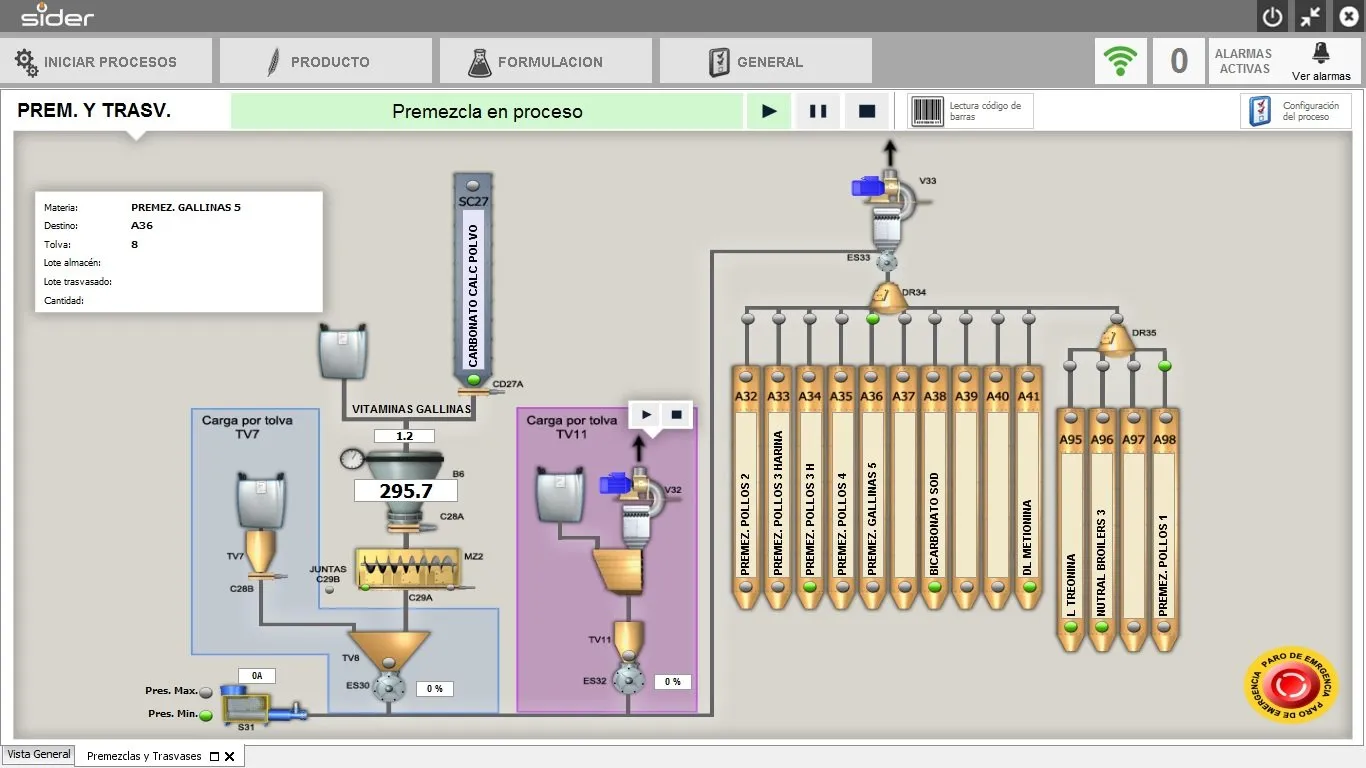
What SuitER Tracer does
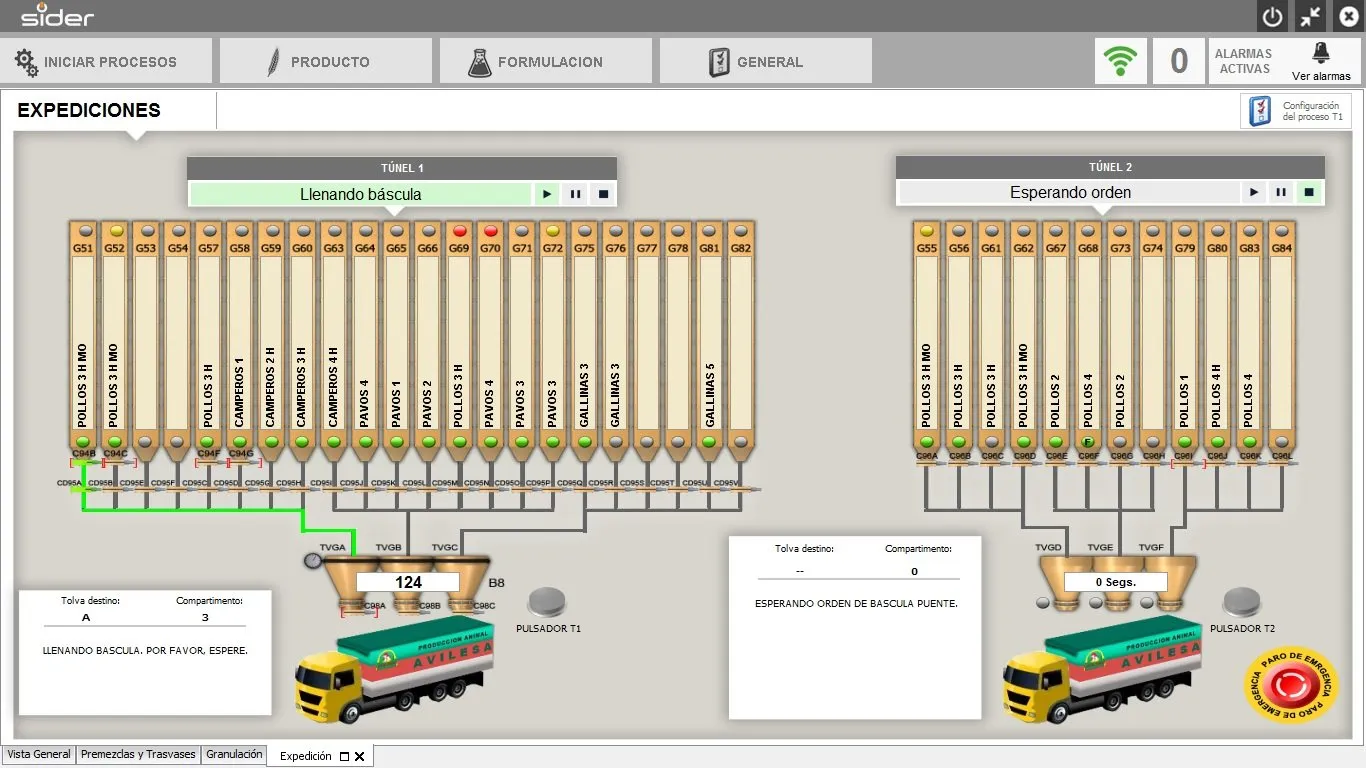
In our installations, that data is collected by SuitER, the industrial software we develop for agri-food factories. Its core, SuitER Server, connects the PLC network with the management network and stores the data in a database in real time. The traceability module is SuitER Tracer: each batch is linked to its origin, its formula, its dates and its production parameters, and is traced from origin to destinations, from destination to origins and within the plant. It integrates with the ERP, with formulation programs and with NIR analysers. You can see it in the SuitER demonstration on our YouTube channel.
From sensor to ERP: where traceability data lives
A batch's data is not in one place but spread across layers. The reference model for organising them is the ANSI/ISA-95 standard, adopted as an international standard under the number IEC 62264 [12][13]: the physical process, sensors and actuators, control and supervision, manufacturing operations management (where the MES works, and with it traceability) and business planning (the ERP). SCADA sits across two of them: it supervises control in real time, and ISA itself lists it alongside the MES among the systems that manage manufacturing operations [12].
Knowing which layer each piece of data lives in avoids the most common mistake: asking a system for something that is not its job. An ERP is not built to receive a temperature every second, and an operator does not need the month's margin on their screen.
| Layer | What it contains | What data it leaves for traceability | Typical pace |
|---|---|---|---|
| Field | Sensors, load cells, flow meters, probes | Weight, flow, temperature, level | Continuous |
| Control | PLCs, drives, remote I/O | Which silo opens, which recipe runs, which alarm goes off | Milliseconds |
| Supervision | SCADA, operator screens, historians | Sequence of what happened, with timestamps | Seconds to minutes |
| Operations | MES and traceability | Actual consumption per batch, destinations, losses | Per batch, shift or day |
| Company | ERP | Sales order, delivery note and customer for each batch | Days and weeks |
What each piece does on its own is explained in what is a PLC and in SCADA systems in agri-food plants.
The mock recall: proof that it works
A traceability system only proves that it works when it is used in a hurry, and Article 19 requires withdrawal to be initiated “immediately” [1]. It is worth rehearsing beforehand with a mock recall. If the plant holds a private certification (IFS, BRCGS or another), that standard sets how often. These are the steps:
- Choose the batch without warning. A raw material batch that came in weeks ago and was used in several production runs.
- Go forward. Which product batches contain it, in what quantity and which customers they have gone to.
- Go back. From one of those product batches, all its raw materials with their batches and suppliers.
- Reconcile the quantities. What came in from the batch must equal what was consumed, plus what is left, plus the recorded losses. If it does not add up, a record is failing somewhere, and the matrix above helps to find it.
- Time it and note what had to be looked up by hand. Every piece of paper, email or phone call that was needed is a point to automate.
The result comes down to two figures: how long it took and how much product would have to be recalled. With internal traceability properly recorded, the second figure gets close to what actually contained the affected raw material; with internal traceability on paper, it usually includes everything that might have contained it.
How we do it at ER Ingeniería
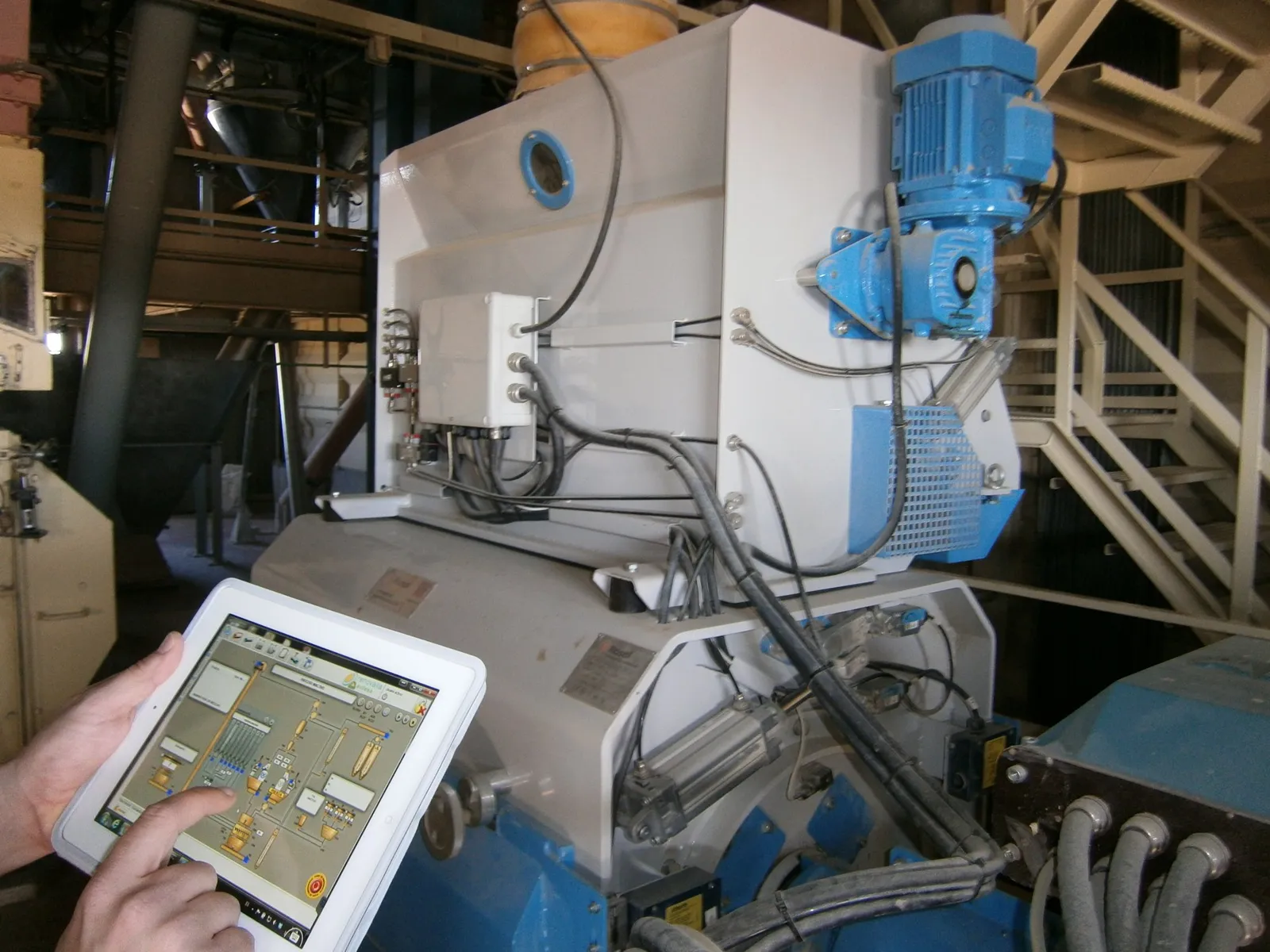
We start with an on-site diagnosis, with questions like those in the matrix above; then we program PLCs and SCADA so that the data originates in the machine, and we implement SuitER to store and query it. We work mainly in wineries and feed mills and in food industry plants. On our YouTube channel you can see three feed mills we have worked on: Inalsa, Agrocantabria and Casaseca.
Shall we review your plant's traceability?
Tell us what you produce and how you currently record batches, weighings and dispatches. We will tell you what can be captured from the PLCs you already have and what needs new equipment.
See SuitER Tracer Talk to our teamOr call us on 967 140 850
Frequently asked questions about food traceability
What is food traceability?
It is the ability to trace and follow a food, feed or ingredient through all stages of production, processing and distribution. In the European Union it is mandatory for food and feed businesses under Regulation (EC) 178/2002.
What does the law require of a food business regarding traceability?
Article 18 of Regulation (EC) 178/2002 requires businesses to identify their suppliers and the businesses to which they supply their products, and to have systems and procedures in place to provide that information to the authorities on demand. This is the one step back, one step forward approach.
What are the three types of traceability?
Backward, which identifies the suppliers of each raw material; internal or process, which links incoming batches to batches of finished product; and forward, which identifies which customers each product goes to. Article 18 of Regulation (EC) 178/2002 expressly requires the first and the third, but not the batch number: the European Commission recommends recording it, and for food of animal origin Regulation 931/2011 does require it.
Is internal traceability mandatory?
Article 18 of Regulation (EC) 178/2002 does not expressly require it, but the European Commission's guidance notes that it allows more targeted and accurate withdrawals. In feed mills, Regulation (EC) 183/2005 requires the manufacturing history of each batch to be traceable.
Why do manual traceability records fail?
Because they are written after the work, copied between paper, spreadsheets and the ERP, and depend on someone transcribing batch codes and weighings correctly with the line running. The weak points are reception, silos that mix batches, weighings and times.
How is traceability automated in a factory?
By storing what the PLC already knows: the batch read at reception, the destination silo, the actual weight of each ingredient, the time of each event and the silo each load leaves from. Software such as SuitER Tracer stores those events and traces each batch backward and forward.
How long do traceability records have to be kept?
Article 18 of Regulation (EC) 178/2002 does not set a minimum period: it is up to the business. The European Commission's guidance considers that five years from manufacture or delivery would probably meet its objective, and suggests six months for highly perishable products supplied directly to the final consumer and the shelf life plus six months for products with a best-before date. For food of animal origin, Regulation 931/2011 requires the information to be kept available at least until it can reasonably be assumed that the food has been consumed.
What is the difference between SCADA, MES and ERP?
SCADA supervises the process in real time. The MES manages manufacturing operations: production orders, batches, consumption and stoppages. The ERP manages the business: sales orders, purchasing, stock and costs. In the ISA-95 model (IEC 62264), the MES is level 3 and the ERP level 4; plant traceability lives at level 3.
Sources
- Regulation (EC) No 178/2002 of the European Parliament and of the Council of 28 January 2002 laying down the general principles and requirements of food law, establishing the European Food Safety Authority and laying down procedures in matters of food safety (Arts 3, 18, 19 and 65). Official Journal of the European Communities, L 31. https://eur-lex.europa.eu/legal-content/ES/TXT/?uri=CELEX:02002R0178-20260101
- Directive 2011/91/EU of the European Parliament and of the Council of 13 December 2011 on indications or marks identifying the lot to which a foodstuff belongs (Arts 1 and 3). Official Journal of the European Union, L 334. https://eur-lex.europa.eu/legal-content/ES/TXT/?uri=CELEX:32011L0091
- Agencia Española de Seguridad Alimentaria y Nutrición. (2009). Guía para la aplicación del sistema de trazabilidad en la empresa agroalimentaria (section 6.3). https://www.aesan.gob.es (PDF)
- European Commission, Standing Committee on the Food Chain and Animal Health. (2010, 26 January). Guidance on the implementation of Articles 11, 12, 14, 17, 18, 19 and 20 of Regulation (EC) No 178/2002 on general food law (section III.3.2). https://food.ec.europa.eu (PDF)
- Regulation (EC) No 183/2005 of the European Parliament and of the Council of 12 January 2005 laying down requirements for feed hygiene (Annex II, “Record-keeping”). Official Journal of the European Union, L 35. https://eur-lex.europa.eu/legal-content/ES/TXT/?uri=CELEX:02005R0183-20220128
- Agencia Española de Seguridad Alimentaria y Nutrición. (n.d.). Seguridad alimentaria: trazabilidad. https://www.aesan.gob.es/seguridad-alimentaria#trazabilidad
- European Commission, Directorate-General for Health and Food Safety. (2026). Alert & Cooperation Network: 2025 annual report (p. 7). Publications Office of the European Union. https://food.ec.europa.eu (PDF)
- Commission Implementing Regulation (EU) No 931/2011 of 19 September 2011 on the traceability requirements set by Regulation (EC) No 178/2002 of the European Parliament and of the Council for food of animal origin (Art. 3). Official Journal of the European Union, L 242. https://eur-lex.europa.eu/legal-content/ES/TXT/?uri=CELEX:32011R0931
- Regulation (EC) No 852/2004 of the European Parliament and of the Council of 29 April 2004 on the hygiene of foodstuffs (Art. 5). Official Journal of the European Union, L 139. https://eur-lex.europa.eu/legal-content/ES/TXT/?uri=CELEX:02004R0852-20210324
- Medicines and Healthcare products Regulatory Agency. (2018). 'GXP' Data Integrity Guidance and Definitions (revision 1, sections 3.10, 6.1 and 6.11.2). https://assets.publishing.service.gov.uk (PDF)
- GS1. (n.d.). GS1 Application Identifier (10): Batch or lot number. https://ref.gs1.org/ai/10
- International Society of Automation. (n.d.). ISA-95 Standard: Enterprise-Control System Integration. https://www.isa.org/standards-and-publications/isa-standards/isa-95-standard
- International Electrotechnical Commission. (2013). IEC 62264-1:2013 Enterprise-control system integration. Part 1: Models and terminology. https://webstore.iec.ch/en/publication/6675