
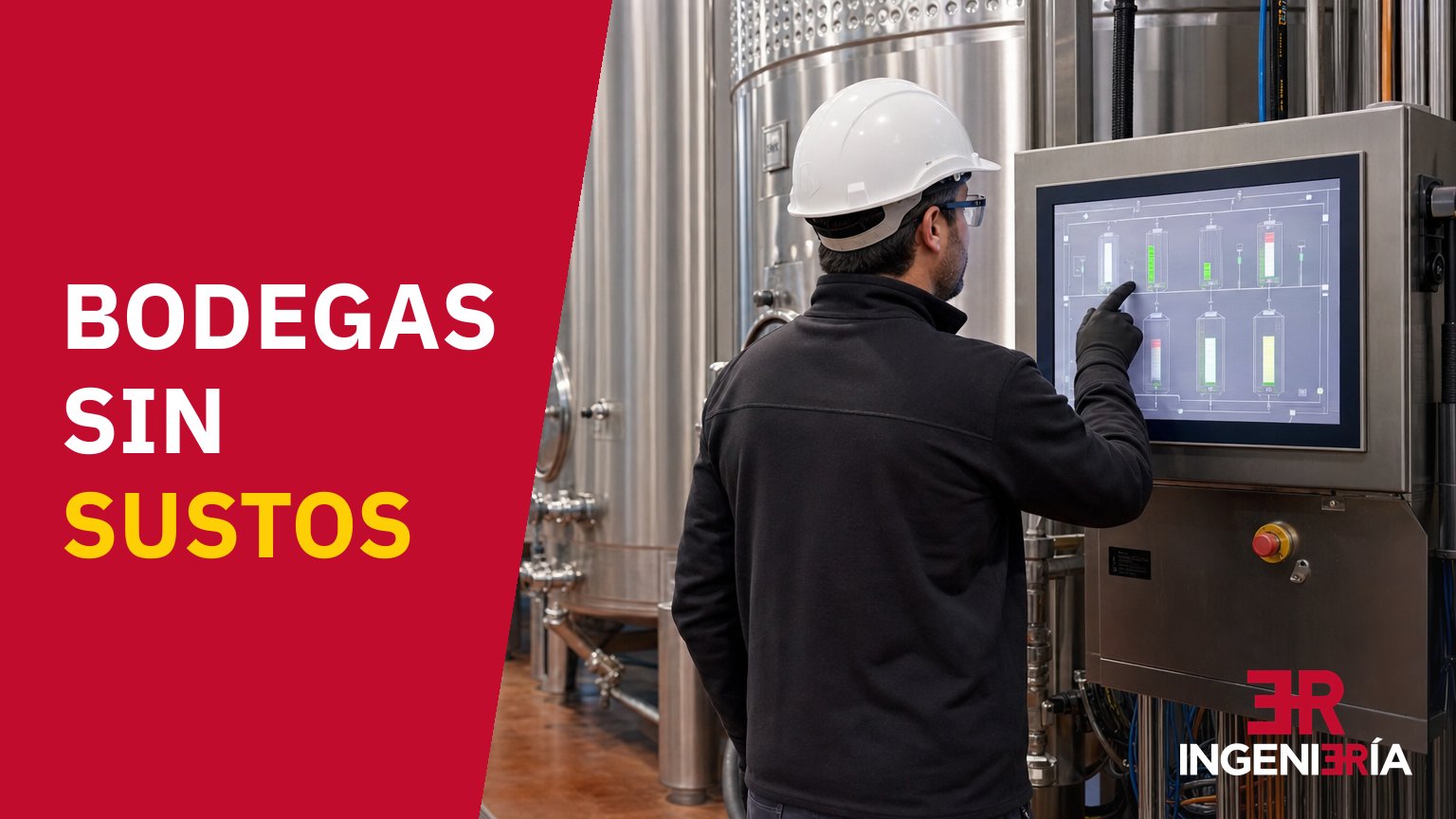
Winery automation: what is automated in each process and what data it generates
Wineries · Process automation
Winery automation means having a control system run the operations that repeat every season: cooling each fermentation tank, pumping over, racking, cleaning the circuits, ventilating the room when CO₂ rises and recording what comes in, what is made and what goes out. The winemaker still sets the setpoint. The system keeps to it day and night, warns when something drifts and keeps a written record of what has happened.
In this article we walk through a winery process by process: what is automated at each point, with what equipment and what data is stored. We tell it from the engineering side: since 1981 we have been doing electrical engineering and automation; today we program PLCs and SCADA systems, have our own software and have automated 45 agri-food factories. If what you are looking for is someone to design and carry out the project, you will find it on our winery automation page.
The short version: in a winery you first automate what costs the most and carries the most risk when it fails, which is fermentation cooling and CO₂ safety. Pumping over, racking, cleaning and records are added afterwards on the same electrical installation and the same PLC, so it is worth designing everything together even if the work is carried out in phases.
On this page
- Winery automation: what is automated in each process
- Grape reception and weighing: where the batch begins
- Fermentation temperature control, tank by tank
- Cold stabilisation, racking and CIP cleaning
- CO₂ safety in the fermentation room
- Wine and must declarations
- Energy: cooling is the big bill
- PLC, SCADA and SuitER: who does what
- Where to start without stopping the harvest
- Frequently asked questions
- Sources
Process map: what is automated and what data is kept
A winery is not automated all at once or in one go. Each operation has its equipment, its actuator and its data, and they do not all give the same return. This table sums up what is usually automated in a production winery and what is recorded when it is done well.
| Process | What is automated | Data recorded |
|---|---|---|
| Reception and weighing | Connected weighbridge, load identification, hoppers, screw conveyors and must pump with their interlocks | Kilos per load, origin, variety, time and destination tank |
| Fermentation | Temperature probe and cooling (or heating) valve on each tank, with its setpoint or its curve | Temperature per tank every few minutes, valve opening and alarms |
| Pumping over and punching down | Pump or punch-down unit on a programme: how often and for how long | Time and duration of each operation in each tank |
| Fermentation monitoring | Density measured in-line or entered from the laboratory into the same system | Density curve alongside the temperature curve |
| Cold stabilisation | Low setpoint in an insulated tank and control of the chiller or heat exchanger | Temperature and duration of the treatment per batch |
| Racking | Selection of source and destination, automatic valves, pump and flow meter | Litres moved, source, destination and date |
| CIP cleaning | Pre-rinse, detergent and rinse sequence with temperature, time and conductivity | One record per cleaning cycle and circuit |
| Fermentation room | CO₂ detectors, forced extraction by threshold, alarm and signage at the entrance | Concentration, extraction start-ups and alarms |
| Energy | Meters on chillers, panels and rooms; chiller start-up sequence | kWh per unit, per day and per season |
Grape reception and weighing: where the batch begins
A wine's traceability starts at the weighbridge. If the weighing is noted on paper and later typed into a spreadsheet, any identification error travels with the wine all the way to the bottle. Automating reception means connecting the weighbridge to the system and making every weighing carry its load details: who brings it, which plot or variety it comes from and which hopper and tank it goes to.
On the control side, reception covers the hoppers, screw conveyors, destemmer and must pump. What matters are the interlocks: the pump must not start if the path to the tank is not open, the line must stop if a hopper fills up, and two loads must not end up in the same tank without anyone having decided so. It is the area that works the most consecutive hours during harvest.
What the general food traceability regulations require and why manual records fail is covered separately, in food traceability and the errors of manual records.
Fermentation temperature control, tank by tank
It is the core of winery automation. During fermentation, yeast converts the sugar in the grapes into alcohol and carbon dioxide and gives off heat: if that heat is not removed, the must warms up by itself. Setpoints depend on the wine. Pennsylvania State University's agricultural extension service gives the usual fermentation temperature as 15 °C or below for whites and between 20 and 30 °C for reds [1].
The typical installation has three parts. One or more chillers produce chilled water or glycol water, which flows through a main circuit; glycol lowers the freezing point of water and allows operation below 0 °C when needed. Each tank has its own jacket or heat exchange plate with its own valve. And each tank has its own temperature probe. The PLC compares the reading with that tank's setpoint and opens or closes its valve. If there is also a hot water circuit, the same loop can be used to get a sluggish fermentation going or for malolactic fermentation.
The setpoint can be fixed or a curve that changes with the days or with density. Winemaking decides it; the engineering job is to make sure it is met in every tank at once.
And that is the real problem at harvest: every tank calls for cooling at the same time, and the chillers only have so much capacity. Well-designed control shares out the cooling by priority (deviation from setpoint, type of wine, fermentation stage) and monitors the circuit's supply temperature, so that opening one more tank does not leave the others without cooling. The data recorded is twofold: each tank's curve and the hours its valve has been open, which show how much cooling each one has demanded.
Programmed pumping over and punching down
In red wines, the skins rise and form the cap. Pumping over draws must from the bottom and sprays it over the top; punching down pushes the cap down into the liquid. Automating them means giving each tank a programme (how many hours apart and for how many minutes), with a fixed pump per tank or a shared pump and valves that select which tank is served. Each operation is recorded with its time and duration, and the programme is changed from the screen, not with a note to the night shift.
Density monitoring
As the sugar turns into alcohol, the density of the must falls as fermentation progresses, and tracking it daily is what tells you where each tank stands. There are two ways to bring it into the system: measure it in the laboratory and enter it in the same program that stores the temperatures, which is the cheapest step, or install density measurement in the tank. In both cases the useful thing is to see the two curves together: a density that stops falling while the temperature is on setpoint is the first warning of a fermentation that is stalling.
Cold stabilisation, racking and CIP cleaning
Tartaric stabilisation. To stop potassium bitartrate crystallising in the bottle, the wine is chilled and kept cold until it precipitates in the tank. It is usually done at a temperature just above each wine's freezing point, which depends mainly on its alcohol content: a 12% vol. wine freezes at around −5 °C [2]. Automating it means giving that insulated tank a low setpoint and controlling the chiller or heat exchanger so that the wine reaches that temperature and stays there without freezing. The temperature and time record per batch is the proof that the treatment was carried out as requested.
Racking. Moving wine from one tank to another by hand is a common source of identification errors. With automatic valves, the operator chooses source and destination on the screen and the system opens the path, checks that no other transfer is running through the same pipes and starts the pump. An in-line flow meter shows how many litres have been moved. That figure feeds the per-tank stock levels used in the winery's declarations (see below).
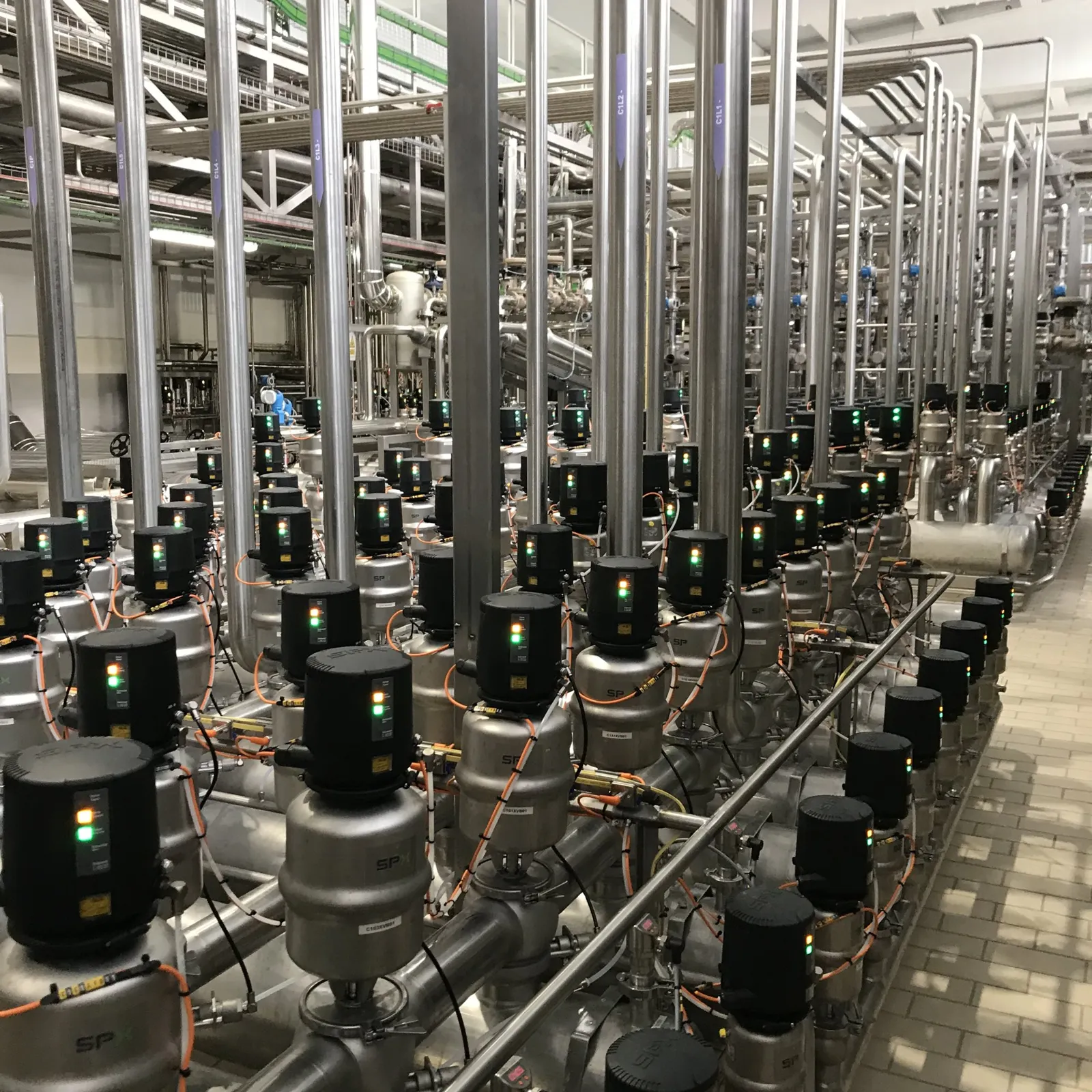
CIP cleaning. Closed-circuit cleaning runs through pre-rinse, hot detergent, rinse and, depending on the case, an acid and a final rinse. When automated, each step runs at its temperature, for its time and at its flow rate, and the conductivity of the water shows when rinsing is complete. The system keeps one record per cycle: which circuit or tank was cleaned, when and with what parameters.
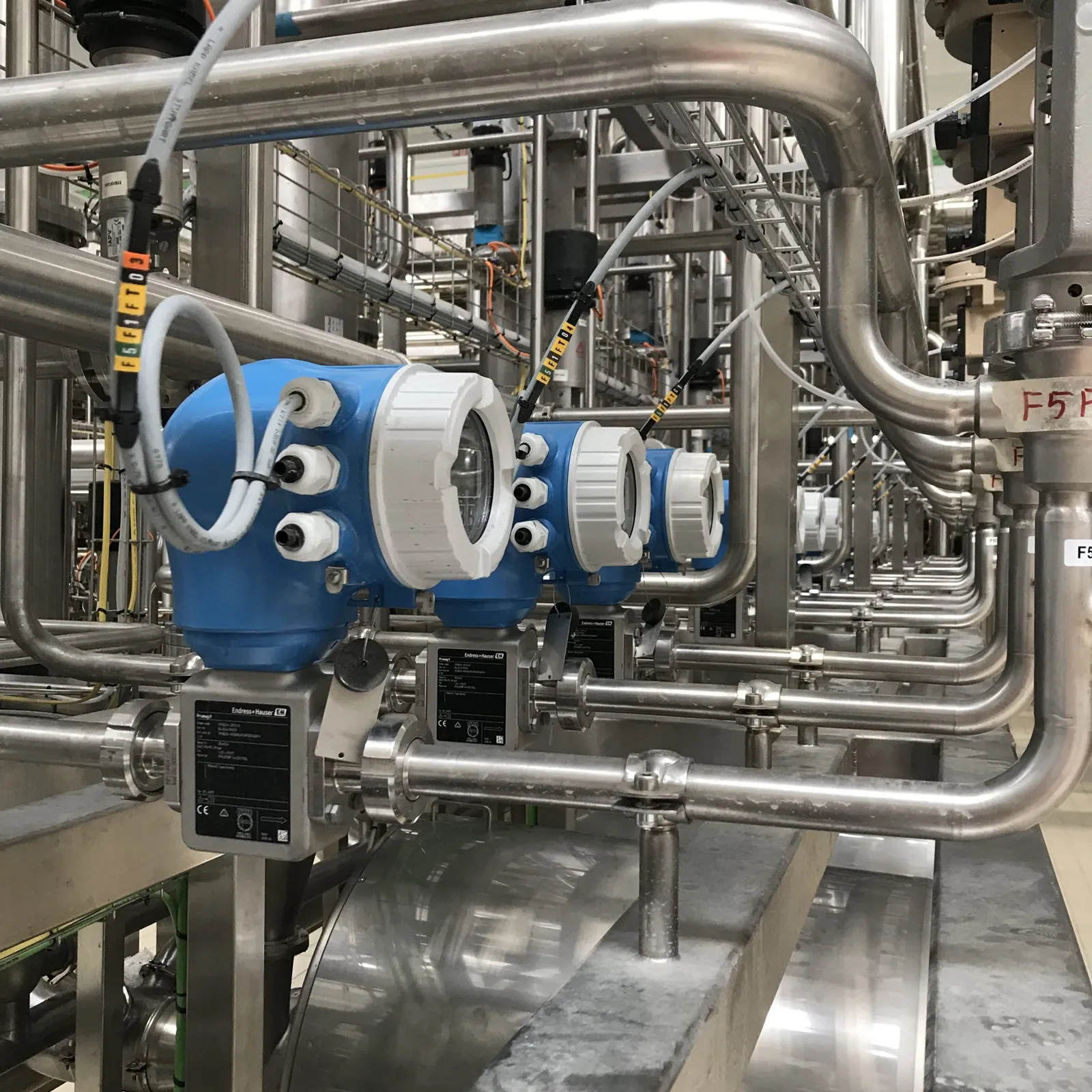
CO₂ safety in the fermentation room
Fermentation produces large amounts of carbon dioxide. The INSST (Spain's National Institute for Safety and Health at Work) describes it in its sheet on emptying red wine fermentation tanks: it is a colourless, odourless gas, heavier than air, which displaces oxygen in the lower part of the tank; it is a simple asphyxiant and, at high concentrations (more than 30,000 ppm), there is a risk of loss of consciousness and death [3]. Its daily exposure limit value (VLA-ED) is 5,000 ppm [3]. For the same reason it builds up in pits, sumps and low areas of the room.
The sheet calls for the tank room to have general ventilation, natural or forced, to replace the air removed by the extraction systems, and for extraction, meters and detectors to be maintained periodically with documented records [3]. Automation adds fixed detection to that. We design it with fixed CO₂ detectors at the height where the gas accumulates and two thresholds: the first starts forced extraction, with intakes near the floor, and the second triggers the audible and visual alarm in the room and at the entrance. The PLC records the concentration and every start-up, and warns if a detector fails or is due for inspection.
Entering a tank is another matter. The INSST calls for tanks that are confined spaces to be identified, for CO₂ to be measured before any work inside and for entry to be made with personal detectors with alarms [3]. The room system does not replace that procedure.
What we ask for before designing detection: a plan of the room showing pits and low areas, the tanks that ferment at the same time and the air inlets. With that we decide where the detectors go, how much extraction is needed and where the make-up air comes in.
Wine and must declarations: what the rules require and how often
In Spain, producers and merchants declare the wine and must held at each facility in INFOVI. Real Decreto (Royal Decree) 739/2015, which implements Regulation (EU) No 1308/2013 as regards declarations in the wine sector, has distinguished by size since its 2016 amendment: “merchants and producers whose average production of wine and must is greater than or equal to 1,000 hl” submit “a monthly declaration of wine and must per facility no later than the twentieth day of each month”, while producers of less than 1,000 hl submit it in December and August [4]. Those exempt include, among others, anyone who obtains less than 10 hectolitres by making wine from purchased products, with no commercial purpose [4].
Much of the data in that declaration originates in the operations in the table at the start: kilos of grapes received and litres moved from one tank to another. The control system does not submit the declaration, but if reception and racking record their data, the stock per tank, which added together gives the stock for the facility, comes from the record and not from a reconstruction at the end of the month.
Energy: cooling is the big bill
In a winery, cooling is the dominant load. According to Wine Australia, in a project by the Australian Wine Research Institute (AWRI), refrigeration can account for between 50% and 70% of an Australian winery's electricity consumption [5]. In Europe, the TESLA project, which brought together practices from European wineries, notes that cooling processes can represent close to 50% of all the energy they consume [6]. And that consumption is concentrated into a few weeks: harvest and stabilisation put the chillers to work, while for the rest of the year demand drops sharply.
That is why automating cooling has a second side: energy. With meters on each chiller and on each room's panels, you know how much each season and each operation costs. With the chiller start-up sequence controlled by the PLC, you avoid running two machines at half load when one would be enough. And with the hours of open valve per tank, you can see which tanks demand more cooling than expected, which is usually a problem of insulation, jacket or setpoint.
Operations that can be scheduled, such as stabilisation, can be programmed for the hours when energy is cheapest or, if the winery has solar panels, for the hours of solar production. For more on solar panels, see our self-consumption installations page.
PLC, SCADA and SuitER: who does what
The split is the same as in any process plant. The PLC, in the panel, runs the temperature loops, the racking and cleaning sequences and the safety interlocks; if the communications network or the computer goes down, the winery stays under control. We explain it in detail in what is a PLC. The SCADA is the screen: the map of tanks with their temperature and status, the alarms and the historical data. How one is designed and what functions it has is covered in our guide to SCADA systems.
On top sits SuitER, our industrial software. SuitER Server collects data from the PLCs in real time, SuitER Reporter produces the reports and SuitER Tracer links each batch to its origin, dates and production parameters, and traces it in both directions.
Where to start without stopping the harvest
A winery's constraint is the calendar: whatever has not been tested before harvest gets tested in the middle of the season or waits a year. That is why we work in this order:
- Inventory of what is there: tanks, jackets, valves, probes, chillers, panels and wiring. Much of the existing equipment can be reused.
- CO₂ safety, if the room has no automatic detection and extraction. It comes first because it protects people.
- Cooling per tank, with the batch structure already defined from the weighbridge.
- Racking, cleaning and energy, on the same installation and the same PLC.
- Off-season testing, with water and dry runs, and a running-in period with manual control available at the panel.
A typical scenario: a winery with a local thermostat on each tank, no records and the chiller run manually. The first step is to bring probes and valves into the PLC, install the screen and keep manual control at each panel. By the next harvest there are already curves per tank and a measured cooling consumption.
After commissioning, our SatER technical service handles any incidents.
Shall we look at automating your winery?
Tell us how many tanks you have, how you produce cooling today and what you record by hand. With that we will tell you where to start and what installation is needed.
Winery automation SuitER software Talk to our teamOr call us on 967 140 850
Frequently asked questions about winery automation
What is automated in a winery?
Whatever repeats every season: grape reception and weighing, the fermentation temperature of each tank, pumping over, racking, cold stabilisation, CIP cleaning, CO₂ detection and extraction, and the recording of all of it. Each operation leaves data: kilos per load, temperature curves, litres moved or cleaning cycles.
How is fermentation temperature controlled in a winery?
With a probe and a valve on each tank. The chillers produce chilled or glycol water that flows through the tank's jacket or plate, and the PLC opens or closes each tank's valve to hold the setpoint or curve set by the winemaker, sharing out the cooling when every tank calls for it at once.
Why is CO₂ dangerous in a winery?
Because fermentation produces a lot of carbon dioxide, which is heavier than air, displaces oxygen in low areas and is a simple asphyxiant. The INSST gives a daily exposure limit value of 5,000 ppm and calls for general ventilation in the room, measurement before entering a tank and personal detectors with alarms.
What does a winery have to declare, and how often?
Under Real Decreto 739/2015, producers and merchants submit a wine and must declaration in INFOVI for each facility. Merchants and producers with an average production of 1,000 hl or more submit it every month, no later than the 20th; producers of less than 1,000 hl, in December and August. If reception and racking are automated, much of that data comes from the winery's own records.
What is the biggest electricity load in a winery?
Refrigeration. According to Wine Australia, it can account for between 50% and 70% of an Australian winery's electricity consumption, and the European TESLA project puts it at close to 50% of all energy. That is why it pays to measure cooling per chiller and per room and to schedule whatever can be timed for the cheapest hours.
Can a winery be automated without stopping the harvest?
Yes, if it is planned outside the season. The existing installation is inventoried, the work is carried out between harvests, it is tested with water and dry runs, and manual control is kept at the panels during the first season with the new system.
What is the difference between the PLC and the SCADA in a winery?
The PLC, in the electrical panel, runs the temperature loops, sequences and interlocks, and keeps controlling the winery even if the computer goes down. The SCADA is the screen where you see the tanks, alarms and historical data, and change the setpoints.
Sources
- Penn State Extension. (n.d.). Wine production. The Pennsylvania State University. https://extension.psu.edu/food-safety-and-quality/grape-and-wine-production/wine-production/
- Butzke, C. (n.d.). Wine cold stability issues (FS-54-W). Purdue Extension, Purdue University. https://www.extension.purdue.edu/extmedia/fs/fs-54-w.pdf
- Instituto Nacional de Seguridad y Salud en el Trabajo. (2018). Basequim 025. Descubado de vino tinto: exposición a etanol y a dióxido de carbono [Emptying red wine fermentation tanks: exposure to ethanol and carbon dioxide]. INSST. https://www.insst.es/stp/basequim/025-descubado-de-vino-tinto-exposicion-a-etanol-y-a-dioxido-de-carbono-2018
- Real Decreto 739/2015, de 31 de julio, sobre declaraciones obligatorias en el sector vitivinícola [Royal Decree 739/2015 of 31 July on mandatory declarations in the wine sector] (arts. 1 and 5, as currently in force, worded by Real Decreto 313/2016). Boletín Oficial del Estado. https://www.boe.es/buscar/act.php?id=BOE-A-2015-8647
- Wine Australia. (n.d.). Winery refrigeration efficiency. https://www.wineaustralia.com/growing-making/winery-refrigeration-efficiency
- EU CAP Network, European Commission. (n.d.). Increasing energy efficiency in wine production (TESLA project). https://eu-cap-network.ec.europa.eu/projects/increasing-energy-efficiency-wine-production_en