
Feed mill automation: what is controlled at each stage of production
Automation · Feed mills
Compound feed manufacturing almost always follows the same chain: raw material reception at the intake pit, storage in silos, grinding, dosing, mixing, steam conditioning and pelleting, cooling and dispatch in bulk or in bags. Feed mill automation puts each stage under the control of a PLC that runs the sequence and of plant software that stores what happened in each batch: which material went into which silo, how much each ingredient weighed, at what temperature the mash was conditioned and which truck it was loaded onto.
Spain is the largest producer of compound feed in the European Union, with 38.8 million tonnes in 2024 according to the Spanish Ministry of Agriculture [1]. We have automated 45 agri-food factories, and our SuitER software was born for feed mills. Here we go through the process stage by stage: what is measured, what the PLC controls, what tends to go wrong and what data must be recorded. If you are looking for someone to design it and commission it for you, see our feed mill automation page.
The short version: in a feed mill, many quality and traceability problems come from three places: unloading into the wrong silo, weighing outside the formula or a poorly homogeneous mix and, where medicated feed is produced, carry-over into the next batch. A good control system makes them much harder and keeps a record of what happened in each batch.
On this page
- The feed manufacturing process at a glance
- Reception and intake pit
- Raw material silos
- Grinding
- Dosing and micro-dosing
- Mixing and homogeneity
- Conditioning and pelleting
- Cooling, finished product and dispatch
- Medicated feed: carry-over and production sequence
- What the regulations require to be recorded
- How we automate a feed mill at ER
- Frequently asked questions
- Sources
The feed manufacturing process at a glance
The table summarises each stage; the details are in the sections that follow.
| Phase | Typical equipment | What is automated | Data recorded |
|---|---|---|---|
| Reception | Weighbridge, intake pit, bucket elevator, pre-cleaner, magnet | Unloading routes, cascade start and stop, level interlocks | Supplier, delivery note, material, batch, net weight, destination silo, date |
| Silos | Raw material silos, level probes | Silo, material and batch assignment; locking of silos on hold | Contents, batch and stock of each silo |
| Grinding | Hammer or roller mill, feeder with variable-speed drive | Feed rate regulated by motor load, protections | Tonnes ground, screen fitted, power consumption |
| Dosing | Macro and micro scales, dosing screws, liquids | Weighing by formula, fast and slow feed, tolerances | Setpoint and actual weight of each ingredient, deviations |
| Mixing | Horizontal mixer, liquid addition, surge hopper | Loading order, dry and wet mixing times | Actual times, incidents, mix number |
| Pelleting | Steam conditioner, pellet mill, steam valve | Conditioning temperature, load-based feeding, blockages | Temperature, load and tonnes per hour for the batch |
| Cooling and product | Cooler, fines screen, finished product silos | Cooler discharge, fines return, product destination | Finished product silo and the batch it contains |
| Dispatch | Bulk loading bins, loadout scale, bagging machine | Loading by compartment, locking out the wrong product | Batch, truck, compartment, customer, weight, date |
We explain what a PLC is and how it works in what is a PLC, and the supervision layer in our guide to SCADA systems.
Reception and intake pit
The truck is weighed on the weighbridge, a sample is taken and it unloads into the intake pit. A bucket elevator and several conveyors carry the grain, through the pre-cleaner and the magnet, to the assigned silo.
What the PLC controls. The route: which conveyors start and which way the diverter valves open. Equipment is started in cascade from the end of the line back towards the intake pit and stopped in reverse order, so that no machine receives product if the next one is stopped. Rotation sensors warn of a blockage in elevators and chain conveyors, and the silo's high-level probe cuts off unloading before it overflows.
What goes wrong. The destination: maize in the barley silo, or a new batch on top of another without it being recorded. The route should only start if the silo is assigned to that material.
What is recorded. Supplier, delivery note, material, batch, net weight, date and destination silo. Regulation (EC) 178/2002 requires being able to identify who supplied each material [5], and the feed hygiene regulation requires keeping the name and address of suppliers and the delivery date [2].
Raw material silos
If the system does not know which batch is in each silo, traceability breaks down even if everything else is properly recorded.
What is controlled. The level, with maximum and minimum probes or continuous measurement, and the stock calculated from inputs and consumption. Each silo has a material and a status: available, unloading or on hold. A silo on hold, for example pending an analysis, is not offered to dosing.
What goes wrong. Stock that exists only “on paper” and does not add up, and silos holding the remains of two batches. Comparing the calculated stock with the measured level from time to time exposes a scale that weighs incorrectly or an unrecorded unload.
Grinding
The usual set-up is a hammer mill with a screen whose hole size determines the particle size; some lines use a roller mill. Some mills grind each material before dosing (pre-grinding) and others dose first and grind the mix (post-grinding), and the control sequence changes in each case.
What the PLC controls. The feeder has a variable-speed drive and is regulated on the mill motor's load: if the load rises, it slows down; if the mill is running empty, it speeds up. This way the mill works close to its maximum without tripping the protection.
What goes wrong. A broken screen gives no warning: the particle size changes and the mill behaves differently. If the load and flow rate of each batch are stored, the deviation shows up in the trend before it does in the laboratory.
Dosing and micro-dosing
This is where the formula is executed. Cereals, meals and by-products are weighed on macro-ingredient scales; mineral premixes, vitamins, amino acids and additives on micro scales, which are smaller and more precise; fats and molasses by scale or flow meter.
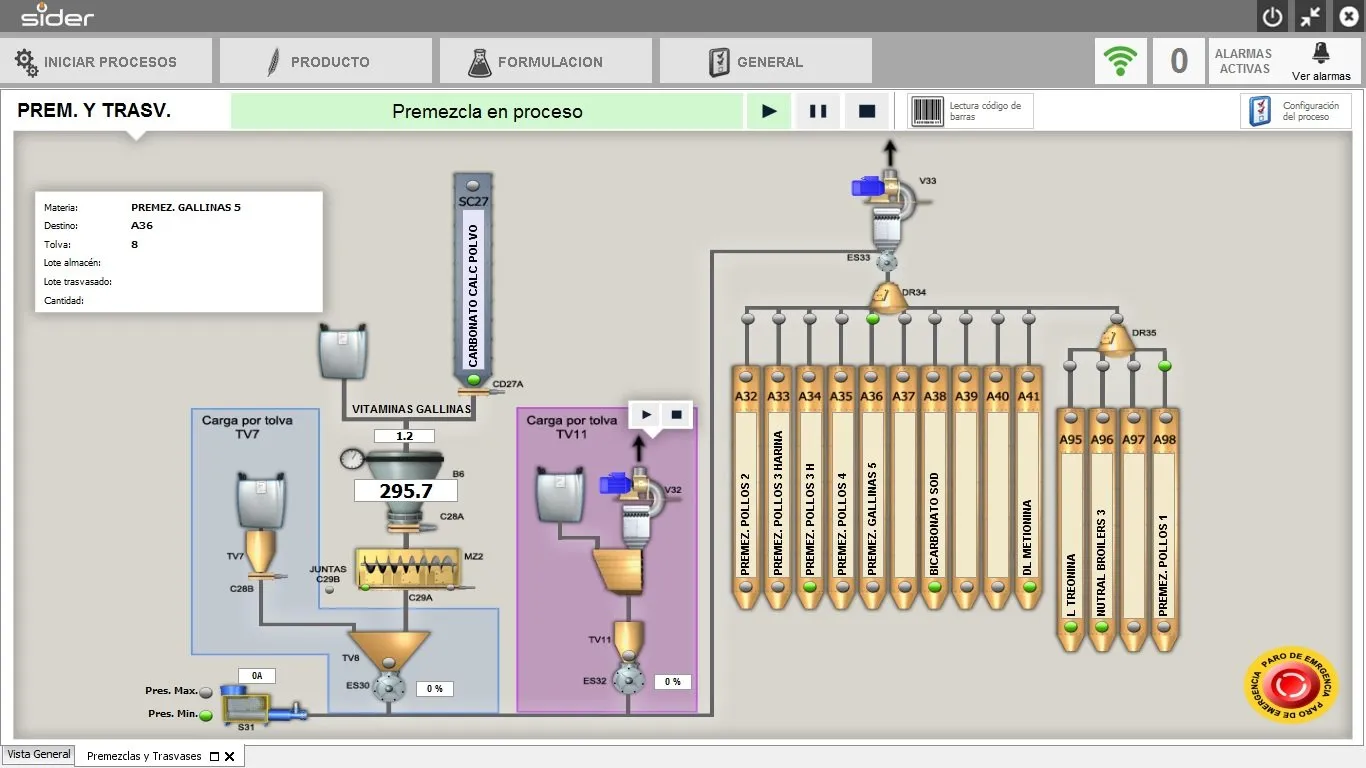
What the PLC controls. Each screw starts at fast speed and switches to slow near the setpoint. The PLC cuts off slightly early, because the product already falling (“in flight”) also counts towards the weight, and it corrects that advance using previous weighings. If an ingredient falls outside tolerance, the mix stops until an authorised person decides.
What goes wrong. A silo that bridges and leaves the screw running empty, a scale out of calibration and, above all, the wrong bag in the micro hopper, which is prevented by reading its barcode before accepting it. Regulation (EC) 183/2005 requires scales appropriate to the weights they measure and regularly tested for accuracy [2].
What is recorded. Per mix: setpoint and actual weight of each ingredient, source batch and who approved each exception.
Mixing and homogeneity
The mixer has to spread a few kilos of premix across several tonnes of cereal. The hygiene regulation requires mixers capable of producing homogeneous mixtures and that the manufacturer demonstrate their effectiveness [2]; for medicated feed, Regulation (EU) 2019/4 requires homogeneous dispersion of the medicine in the feed [3].
How it is demonstrated. With a test: 10 samples from the same mix, a marker analysed in each one (salt is the most common) and the coefficient of variation (CV) between them. Kansas State University rates a CV below 10% as excellent, 10 to 15% as good, 15 to 20% as fair and above 20% as poor. Its publication describes a test in which a 2-tonne ribbon mixer with a worn outer ribbon could not get below 10% when mixing for 3 to 10 minutes; with the ribbon replaced, it achieved it in 4 [6].
What the PLC controls. The loading order, the dry and wet mixing times, the addition of liquids and the discharge into the surge hopper, which allows the next mix to be prepared. The gate does not open before the time set for that formula, and that time comes from the test, not from habit.
What goes wrong. Times shortened to gain output, residues between mixes and worn ribbons or paddles, which cannot be seen from the outside.
Conditioning and pelleting
When the feed is sold as pellets, the mash goes through a conditioner where steam is injected, and then the pellet mill pushes it with rollers through a die. For typical maize and soya diets, the Kansas State University guide gives a reference of 180 to 200 °F for conditioning (around 82 to 93 °C) and 17 to 18% moisture on reaching the die; more complex piglet feeds are pelleted at lower temperatures [7].
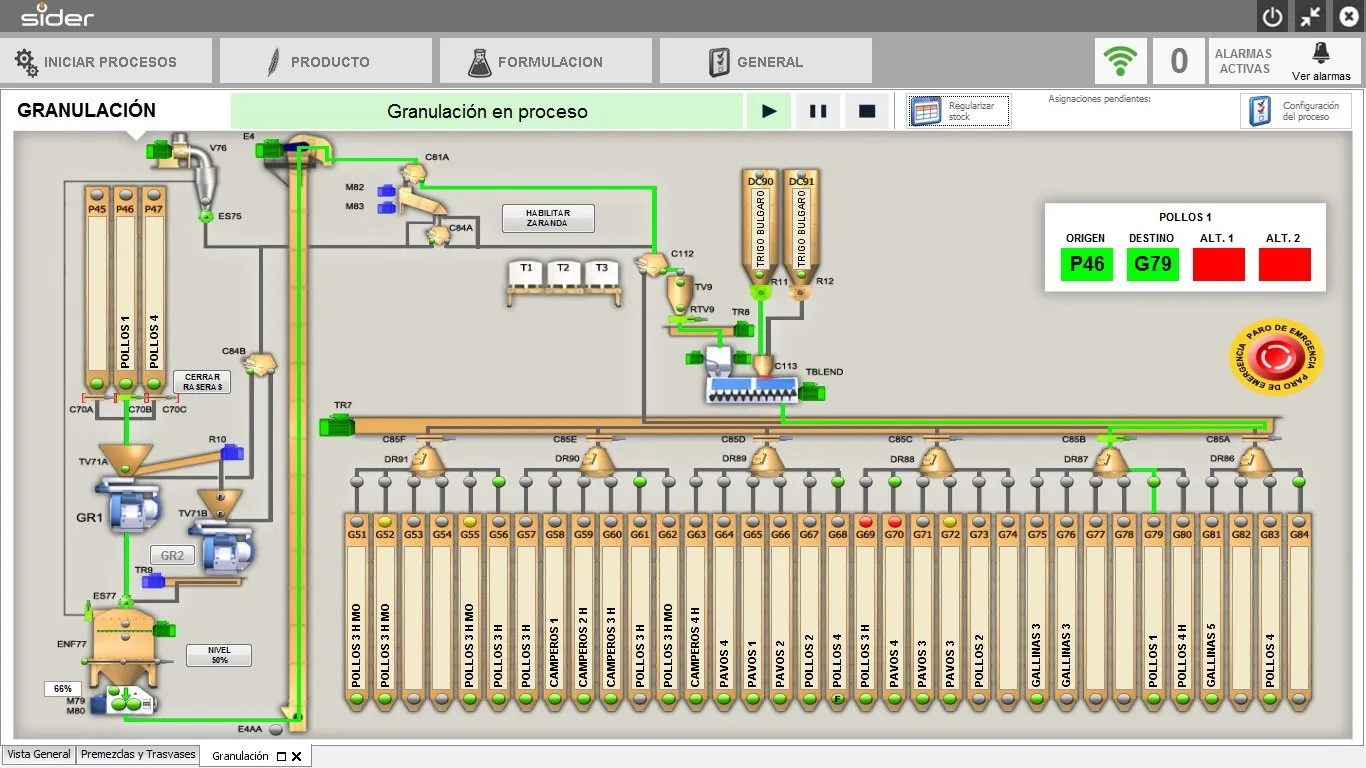
What the PLC controls. Two loops: the steam valve keeps the conditioner outlet temperature at the setpoint for each formula, and the feeder is regulated on the press motor's load. The line starts from the cooler back towards the feeder and, if the press chokes, steam and feed are cut off. The good practice manual published by the FAO and the feed industry gives this as an example of continuous monitoring in a HACCP plan: the temperature of the conditioned mash, recorded by the mill's automation [9].
What goes wrong. The die choking from too much steam or load, and pelleting below the required temperature, which gives a soft pellet with more fines. With the temperature, load and tonnes per hour of each batch stored, a quality complaint can be cross-checked against what happened at the press that day.
Cooling, finished product and dispatch
Cooling must remove the moisture added to the pellet until it is equal to or below that of the mash [7]; in quality tests, the pellet is considered cool when it is within 10 °F (around 5.5 °C) of ambient temperature [8]. A screen separates the fines, which return to the press, and the product goes to the finished product silo specified in the order.
What the PLC controls. Emptying the cooler, the fines return and the route to the silo. In bulk loading, the system only opens the silo containing the ordered product and sends it to the right truck compartment; for bags, the bagging machine weighs and the batch is printed on the bag or its label.
What goes wrong. One customer's product in another customer's compartment, or feed for one species on its way to a different farm. It is the last point at which an error can make its way through to the animal.
What is recorded. Batch, silo, truck, compartment, customer, weight and date. This closes the forward traceability required by Article 18 of Regulation (EC) 178/2002: identifying the businesses to which each product was supplied [5].
Medicated feed: carry-over and production sequence
Medicated feed accounted for 3.9% of the compound feed manufactured in Spain in 2024 [1]. The volume is small, but it shapes the whole plant: any residue in scales, mixer, press or conveyors passes into the next batch.
Regulation (EU) 2019/4, applicable since 28 January 2022, requires measures against this cross-contamination, and its Annex I calls for sequencing or incompatibility rules between productions and, where necessary, dedicated lines [3]. Delegated Regulation (EU) 2024/1229, applicable since 20 May 2025, sets the maximum: if the previous batch was medicated, the next feed may contain at most 1% of the antimicrobial that batch contained, relative to a moisture content of 12%. In some cases the limit drops to the limit of quantification set in the regulation's own annex, for example if the next feed is for animals producing eggs or milk for human consumption [4].
The classic tools are sequencing, flushing with product (“washing” the line) and physical cleaning [9]. In the control system they translate as follows:
- Production sequence. After a medicated feed, a compatible feed or a flush batch is scheduled, and the system does not allow a sensitive formula, such as laying hen feed, to be launched without that step.
- Flagged routes and silos. Silos, scales and routes that have carried medicated feed remain flagged until they are cleaned or flushed.
- Record of the actual sequence. Which batch followed each medicated batch, on which line, with what cleaning and with which batch of veterinary medicinal product.
What the regulations require to be recorded
None of these regulations requires specific software, but the hygiene regulation calls for checks during manufacture and records that allow the manufacturing history of each batch to be reconstructed [2]. If the data is written down by hand, arrives late or is not linked to the batch, proving compliance is much harder.
| Regulation | What it requires | Data that proves it | Where it originates |
|---|---|---|---|
| Regulation (EC) 178/2002, Art. 18 | Identify suppliers and the businesses supplied [5] | Supplier and incoming batch; customer and outgoing batch | Reception and dispatch |
| Regulation (EC) 183/2005, Annex II | Prevent cross-contamination and errors; scales and mixers checked; records that reconstruct each batch [2] | Actual weighings per mix, scale and mixer tests, batch records | Dosing, mixing and dispatch |
| Regulation (EU) 2019/4, Arts. 6 and 7 and Annex I | Homogeneity, measures against carry-over, sequencing rules and records of each medicated batch [3] | Actual production sequence, cleaning operations, medicine batch | Planning, mixing and pelleting |
We explain why manual records fail precisely here, and how batch traceability is set up, in the article on food traceability and manual records.
How we automate a feed mill at ER
Since 1981 we have been doing electrical engineering, installations and automation, and we have automated 45 agri-food factories. SuitER, our plant software, started out as a suite of applications for feed mills: it has a screen for each stage (intake pit, premixes, pelleting, dispatch) and links every weighing, route and load to its batch. Traceability is handled by the SuitER Tracer module, and the whole suite is on our SuitER software page.
In a feed mill we handle the electrical work, PLC programming, supervision software and commissioning, followed by support from our SatER technical service. If the plant has an old system that has fallen short, we approach it as a phased PLC and SCADA modernisation.
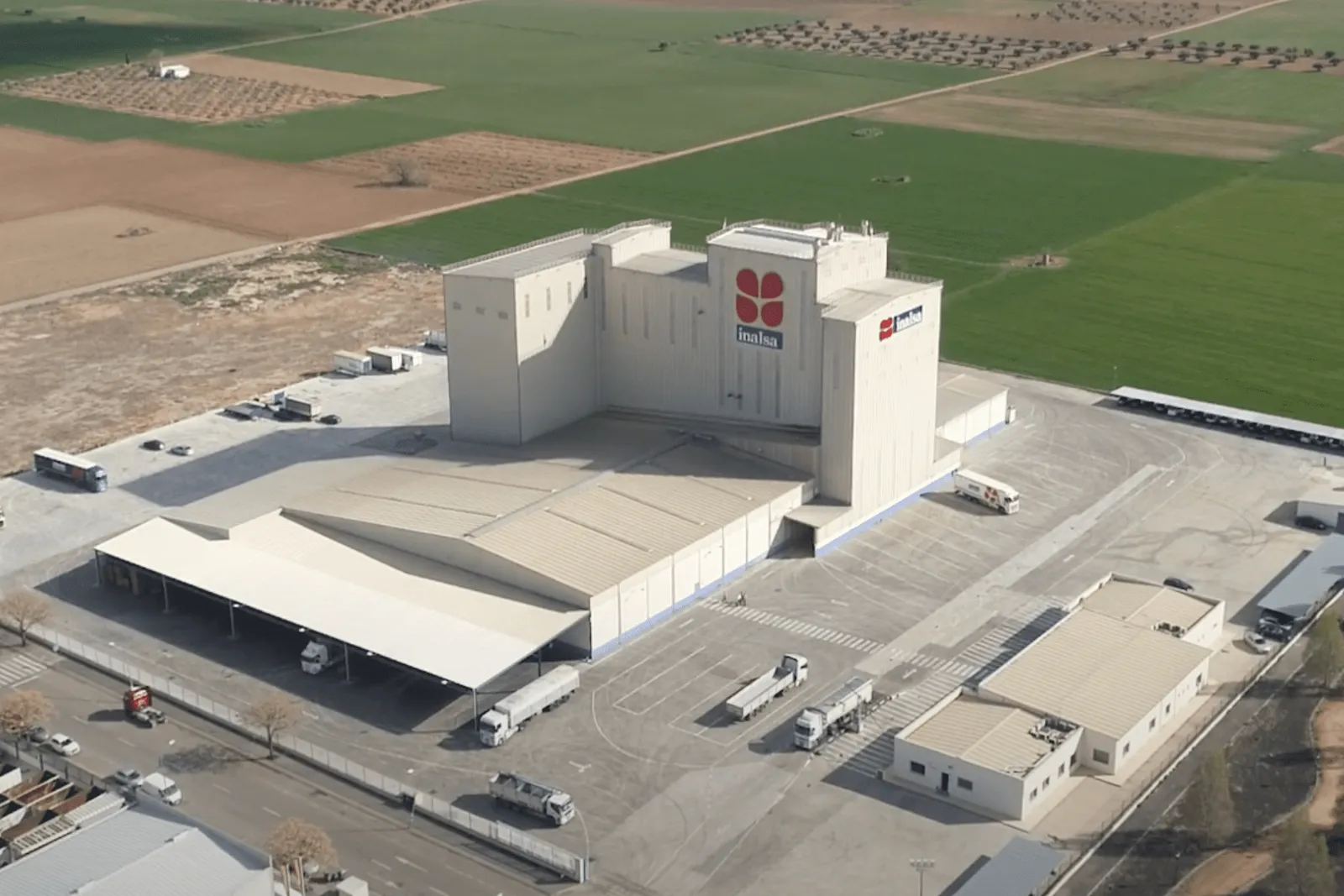
Three of the plants we have worked on have videos on our YouTube channel: Inalsa, Agrocantabria and Casaseca. Others, such as Piensos Sol, Agropal or Gypasa, are on our agri-food industry page.
Shall we review your feed mill?
Tell us which stages you have automated, where things are still recorded by hand and what concerns you ahead of an inspection, and we will tell you where we would start.
Feed mill automation Talk to our teamOr call us on 967 140 850
Frequently asked questions about feed mill automation
What are the stages of compound feed manufacturing?
Raw material reception at the intake pit, storage in silos, grinding, dosing of macro- and micro-ingredients, mixing, steam conditioning and pelleting, cooling, finished product storage and dispatch in bulk or in bags. Some mills grind before dosing and others after.
What is automated in a feed mill?
Practically everything that moves: the unloading and conveying routes, the scales and dosers, the mixing times, the conditioner temperature, the feeding of the mill and the pellet mill, and truck loading. A PLC runs each sequence and the plant software records what happened in each batch.
What is the difference between dosing and micro-dosing in feed?
Macro-ingredient dosing weighs high-volume materials, such as cereals and meals, on high-capacity scales. Micro-dosing weighs mineral premixes, vitamins, amino acids and additives on small, higher-resolution scales, because a few kilos have to be spread evenly across several tonnes.
How do you check that a feed mix is homogeneous?
With a mixer test: 10 samples are taken from the same mix, a marker, usually salt, is analysed in each one and the coefficient of variation is calculated. Kansas State University considers a result below 10% excellent and between 10 and 15% good; Regulation (EC) 183/2005 requires the effectiveness of mixers to be demonstrated in terms of homogeneity.
What do the regulations require of a mill that makes medicated feed?
Regulation (EU) 2019/4, applicable since 28 January 2022, requires ensuring homogeneous dispersion of the medicine and taking measures against cross-contamination, with production sequencing rules. Delegated Regulation (EU) 2024/1229 limits antimicrobial carry-over into the next feed to 1% of what the medicated batch contained, and to the limit of quantification in its annex in some cases.
What data does a feed mill have to record for traceability?
Article 18 of Regulation (EC) 178/2002 requires being able to identify who you bought from and who you sold to, and Regulation (EC) 183/2005 requires keeping suppliers with the delivery date, the formulation and records that make it possible to reconstruct the production of each batch. In practice, that also means recording the batch of each raw material, the silo it was stored in and the actual weighings of each mix.
Can a feed mill that is already in operation be automated?
Yes, and it is the most common case. The work is done in phases, starting with the part that causes the most problems, and changes to electrical panels and programs are prepared so they can be carried out during the plant's scheduled shutdowns.
How much feed is produced in Spain?
Spain produced 38.8 million tonnes of compound feed in 2024 and is the largest producer in the European Union, according to the Spanish Ministry of Agriculture, Fisheries and Food. Medicated feed accounted for 3.9% of that total.
Sources
- Ministerio de Agricultura, Pesca y Alimentación. (2025, 23 September). Spain remains the leading feed producer in the European Union, with 38.8 million tonnes. https://www.mapa.gob.es
- Regulation (EC) No 183/2005 of 12 January 2005 laying down requirements for feed hygiene (Annex II). Official Journal of the European Union, L 35. https://www.boe.es/buscar/doc.php?id=DOUE-L-2005-80251
- Regulation (EU) 2019/4 of 11 December 2018 on the manufacture, placing on the market and use of medicated feed. Official Journal of the European Union, L 4. https://www.boe.es/buscar/doc.php?id=DOUE-L-2019-80008
- Commission Delegated Regulation (EU) 2024/1229 of 20 February 2024 on specific maximum levels of cross-contamination of antimicrobial active substances in non-target feed. Official Journal of the European Union. https://www.boe.es/buscar/doc.php?id=DOUE-L-2024-80616
- Regulation (EC) No 178/2002 of 28 January 2002 laying down the general principles and requirements of food law (Art. 18). Official Journal of the European Communities, L 31. https://www.boe.es/buscar/doc.php?id=DOUE-L-2002-80201
- Stark, C. and Saensukjaroenphon, M. (2017). Testing Mixer Performance (MF3393). Kansas State University. https://bookstore.ksre.ksu.edu/pubs/testing-mixer-performance_MF3393.pdf
- Dunmire, K., Stark, C. and Paulk, C. (2021). Quality Feed Manufacturing Guide: Pelleting. Kansas State University. https://www.grains.k-state.edu (PDF)
- Stark, C. and Fahrenholz, A. (2015). Evaluating Pellet Quality (MF3228). Kansas State University. https://bookstore.ksre.ksu.edu/pubs/evaluating-pellet-quality_MF3228.pdf
- FAO and International Feed Industry Federation. (2010). Good practices for the feed industry: Implementing the Codex Alimentarius Code of Practice on Good Animal Feeding. https://www.fao.org/3/i1379e/i1379e.pdf