

SCADA and PLC modernisation: how to migrate an obsolete system using planned shutdowns
PLC and SCADA · Migration
Modernising a SCADA system and its PLCs in an agri-food plant can be done without adding stoppages to the ones the plant already has scheduled, if it is approached as a staged migration. First, you confirm with the manufacturer which phase of its lifecycle each device is in. Then you inventory what is on the plant floor and choose the migration strategy. Almost everything is prepared while the plant keeps producing, and the final changeover is concentrated into one of those stoppages, with the new system tested before it reaches the plant (FAT) and again on site (SAT) before production starts.
At ER Ingeniería we have been doing process engineering since 1981, based in Villarrobledo. If what you want to know is whether your particular PLC needs upgrading, we explain it step by step in the PLC upgrade guide; and if you need a refresher on what a SCADA system does and how it is set up, it is in our guide to SCADA systems.
The short version: the risk of an obsolete system is measured with three questions. Does the manufacturer still supply spare parts? Is there a copy of the program that could be loaded onto the CPU today? Does the SCADA computer receive security patches? If any answer is “no”, it is time to plan the migration before a breakdown chooses the date.
On this page
- How to tell whether your PLC or SCADA is obsolete
- Inventory before deciding: spare parts, know-how and cybersecurity
- PLC and SCADA migration strategies, and when each one fits
- What is reused from the installation and what is replaced
- Phased migration plan, with FAT and SAT
- What changes in an agri-food factory
- How we do it at ER Ingeniería
- Frequently asked questions
- Sources
How to tell whether your PLC or SCADA is obsolete
The lifecycle status of a PLC is published by the manufacturer for each part number. While the product is active, it is sold and still being developed. When it enters phase-out, the manufacturer announces it with a timetable: for a while it is still sold as new equipment, and then it moves into a phase in which it is only supplied as a spare part [1]. When that period ends, the equipment is discontinued and what remains is repair, sometimes by the manufacturer itself [2], and the second-hand market.
The check is made with the exact part number shown on the rating plate of the CPU and of each module, in the manufacturer's own lifecycle tool. Here are some examples, with the status each manufacturer publishes:
| Platform | Status according to the manufacturer | What it means for the plant |
|---|---|---|
| Siemens SIMATIC S7-300 and ET 200M I/O | Being phased out. In 2023 Siemens announced it would stop selling it: around two more years as new equipment and then around eight years in the spare-parts phase [1]. | Official spare parts are still available, so there is time to plan the migration calmly instead of doing it after a breakdown. |
| Allen-Bradley PLC-5 (Rockwell Automation) | Discontinued: Rockwell lists it as retired (“discontinued”) and offers its own migration programme [2]. | Rockwell repairs and remanufactures the PLC-5 even though it is discontinued, but warns that spare parts, repaired units and technicians who know it are becoming increasingly scarce [2]. Every breakdown depends on a unit being available. |
| SCADA on a PC running Windows XP or Windows 7 | No longer supported by Microsoft: Windows XP since 8 April 2014 [3] and Windows 7 since 14 January 2020 [4]. | The computer that supervises the plant does not receive security patches. If it is also connected to the office network or has remote access, it is a way into the control network. |
| SCADA on a PC running Windows 10 | Unsupported since 14 October 2025 [5]. LTSC editions follow their own timetable: Windows 10 IoT Enterprise LTSC 2021, for example, has extended support until January 2032 [6]. | This is the easiest case to overlook, because the computer looks modern and the application keeps working just the same. You need to check the exact edition of Windows installed on the PC. |
SCADA systems usually age from underneath: the application keeps working, but the Windows it runs on no longer receives patches, and it cannot always be moved to a current one without changing the SCADA version and licence. Something similar happens with the programming software for older PLCs: it often only runs on an old laptop, and if that laptop fails nobody can connect to the PLC.
Inventory before deciding: spare parts, know-how and cybersecurity
No migration should be decided without knowing what is there. The inventory we carry out before proposing anything records, for each line:
- Every CPU, input and output module, communications card, screen and drive, with its part number and lifecycle status.
- The program in each PLC: whether there is a backup copy, what date it is from and whether anyone has compared it with what is loaded in the CPU.
- The programming software with its licence, the signal list and the wiring diagrams, and whether they reflect what is actually wired.
- The communication networks (Profibus, MPI, DH+, serial links) and which devices hang off each one.
- The SCADA: version, licences, number of tags and where it stores historical data, alarms and recipes.
- Who knows the system. If the answer is a single person, that goes into the inventory as one more risk.
Spare parts
The spare-parts store runs down without anyone keeping track: a card is used, it is not replaced because it is no longer made, and the next breakdown finds the shelf empty. The typical scenario is an output card that fails in the middle of the season and whose second-hand replacement takes days to arrive. Counting how many units of each part number are installed and how many are held in reserve shows which line is most exposed.
Know-how
Programs from twenty years ago are rarely commented, and changes made on the fly did not always make it into the drawings. When the person who made them retires, the plant loses the only real documentation. That is why, before touching anything, we write down what each machine does today and go over it with production and maintenance: that document is the basis of the migration.
Cybersecurity
The NIST guide to control system security, revised in 2023, points out that these systems were born isolated and that many older devices have no password protection and use protocols without authentication [7]. That stops being harmless as soon as the SCADA is connected to the office network, to the ERP or to remote maintenance access. That same guide and the ISA/IEC 62443 series of standards [8] are the references for putting it in order: dividing the control network into zones and controlling where each communication comes in and who has access. A migration is the moment to get it sorted, because the network is going to be rebuilt anyway.
PLC and SCADA migration strategies, and when each one fits
The choice depends on how long the plant can be stopped, how many lines there are, whether spare parts are still available for the hardware and how well documented the program is. These are the five options we work with:
| Strategy | How it is done | Pros | Cons | Fits when |
|---|---|---|---|---|
| Full replacement | PLCs, screens, SCADA and network are replaced in a single intervention. | A single commissioning; once it is finished, no old equipment remains running alongside the new. | It needs the longest stoppage and concentrates all the risk into a few days. | The plant has a long annual shutdown or the installation is small. |
| Phased migration | The migration is done by area (intake, dosing, packaging) or by level (first the SCADA, then the CPUs, then the inputs and outputs). | Each intervention fits into a short stoppage; what is learned in the first phase is applied in the following ones. | Two systems coexist for months and gateways between them have to be maintained. | The plant runs all year round and only has weekends or short stoppages. |
| Program conversion | The old program is transferred to the new platform with the manufacturer's conversion tools and then reviewed. | It keeps the logic that works and shortens programming time. | It carries over whatever was badly solved and the uncommented parts. | The program is reasonably well organised and the process is not going to change. |
| Program rewrite | The program is written again from the functional specification drawn up with production. | A structured, documented program, ready to record data. | More engineering hours and more testing. | The program is unmanageable, or the opportunity is taken to change the process. |
| Parallel running | The new SCADA is installed alongside the old one and reads the same PLCs; values and alarms are compared before the old one is removed. | It is validated while the plant keeps producing, and operators learn the new system without pressure. | You have to make sure that only one of the two is in control of each device. | The SCADA is replaced and the PLCs stay, at least for now. |
When the plant runs all year round, we usually propose a phased migration that starts with the SCADA in parallel, which is what least affects production and what most quickly resolves the security of the computer. The CPUs and the inputs and outputs are replaced afterwards, area by area, during the stoppages the plant already has. Whether the program is converted or rewritten is decided after we have reviewed the code. Siemens names the S7-1500 and ET 200MP I/O as the successors to the S7-300 and ET 200M, with hardware migration supported in its configuration tools [1], and Rockwell has its own migration programme for the PLC-5, with tools for automatic code conversion [2]. Whatever is converted is reviewed and tested in full, just like a new program.
What is reused from the installation and what is replaced
In a migration, what has become obsolete is almost never the field level.
| Item | Usual approach | What we check |
|---|---|---|
| Sensors, actuators and field wiring | Reused. | Condition of the insulation, cable labelling and that each signal matches the list. |
| Electrical panels and cable trays | Reused if there is room. | Space and ventilation for the new modules, power supply and protection devices. |
| Input and output modules | Replaced, sometimes in a later phase. | Whether the manufacturer offers adapters to connect the existing wiring to the new module without rewiring terminal by terminal, such as the wiring conversion systems Rockwell has for the PLC-5 [2]. |
| CPU and communication cards | Replaced. | Capacity of the new CPU for the program and for planned expansions. |
| Legacy networks (MPI, DH+, serial) | Replaced by industrial Ethernet, with gateways while both systems coexist. | Which third-party devices (weighing scales, drives, dosing units) communicate over that network. |
| PC, licences and SCADA application | Replaced. | That historical data, alarms and recipes are exported beforehand and can still be consulted afterwards. |
| Process logic and recipes | Kept as the specification. | That production validates in writing how each machine should behave. |
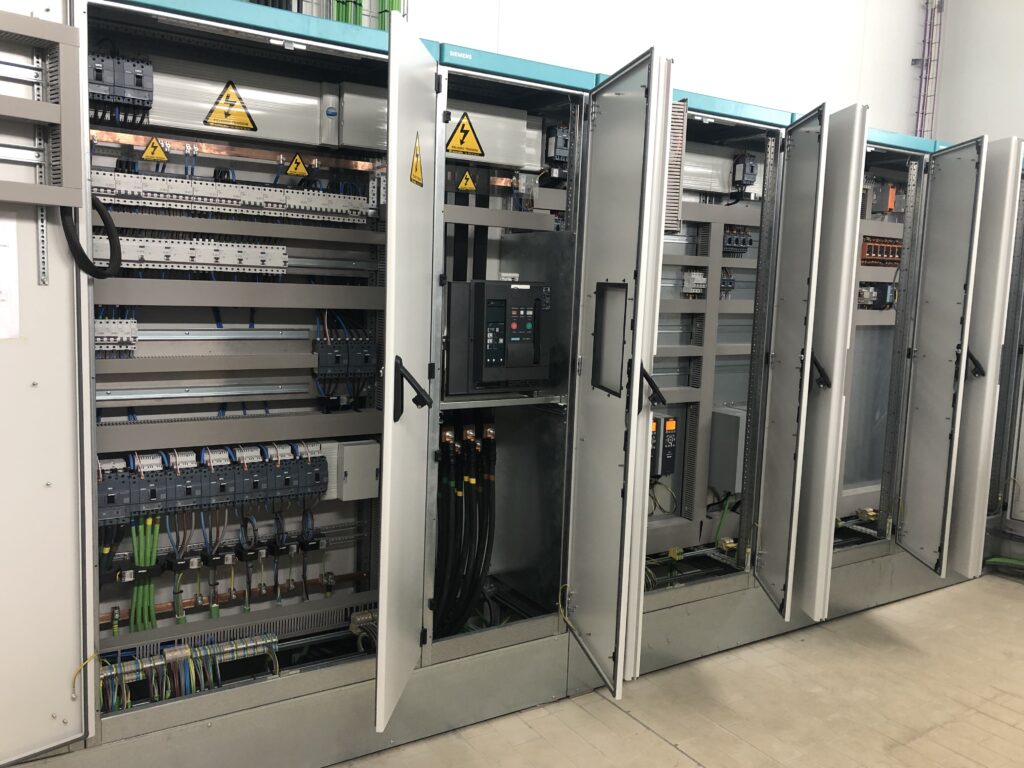
Phased migration plan, with FAT and SAT
The IEC 62381 standard, revised in 2024, sets out requirements and checklists for the factory acceptance test (FAT), factory integration test (FIT), site acceptance test (SAT) and site integration test (SIT) of process automation systems [9]. These tests are what make it possible to reach the stoppage with the new system already tested. This is how we organise a migration:
- Diagnosis and inventory. Everything in the previous section, with a map of which line carries the most risk and in what order it makes sense to act.
- Functional specification. What each machine does today and what it should do afterwards, written down and validated with production, quality and maintenance.
- Engineering and programming. Control and network architecture, PLC programs and SCADA screens.
- FAT before going on site. The program and the SCADA are tested with the panels assembled or with simulated signals, without touching the installation.
- On-site preparation without stopping. Panels and network are installed, the new cable is laid and the SCADA is installed in parallel while the plant keeps producing.
- Changeover during the stoppage. Connection, signal-by-signal checks and a no-load start-up. A written plan for reverting to the old system if something does not respond is brought along; it works as long as the old system has not been dismantled.
- SAT and commissioning with product. Validation with real production: recipes, alarms, interlocks and batch records.
- Training and documentation. Commented programs, updated diagrams and backup copies handed over, plus training for operators and maintenance staff.
What shortens the stoppage most is step 4: a fault that shows up in the FAT is fixed with time to spare and with the plant producing; the same fault on changeover day is fixed with the line stopped. To put figures on that stoppage, see our technical document for calculating the real cost of a production stoppage.
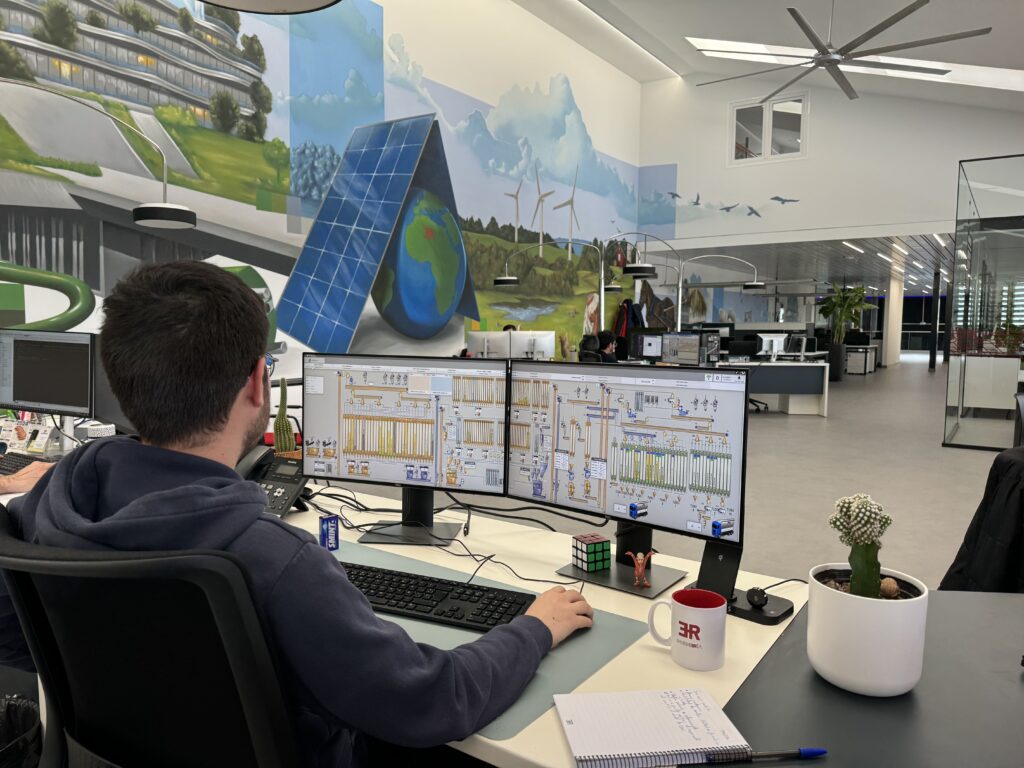
What changes in an agri-food factory
The method is the same as in any industry, but in food production there are three things that shape the timetable and the scope.
Intervention windows
A winery does not touch its control system during the grape harvest, but it has quiet months afterwards. A feed mill usually runs all year round with short weekend stoppages, so it goes in phases. Seasonal industries have their window when the season ends. The plan is adjusted to that calendar.
Batch data
The old SCADA stores batch, recipe and consumption history that the quality department uses to respond to an audit or a product recall. Before the changeover, it is exported and kept accessible, and the new system has to record from the very first batch it produces. If that traceability is currently completed by hand, now is the time to fix it; we cover this in the article on traceability failures caused by manual data.
Symptoms that are not obsolescence
Intermittent dropouts between the SCADA and the PLCs, or frozen tags, do not always call for a new system: sometimes they come down to a cable or a connector. Before migrating, it is worth ruling that out with our article on PLC–SCADA communication failures.
How we do it at ER Ingeniería
We have automated 45 agri-food plants, including plants featured on our website such as those of Inalsa, Agrocantabria and Casaseca. In a migration we do the complete job: inventory, specification, electrical and control engineering, programming, FAT and SAT testing, installation, commissioning and ongoing support through our SatER technical service.
For the supervision and data layer we have SuitER, our industrial software, which integrates with the plant's PLCs and SCADA for production, energy and traceability control, with modules such as SuitER Tracer for batch traceability. What we do in the sector is on our agri-food industry page and on our winery and feed mill automation page.
Shall we review your system before it fails?
Tell us which PLCs and which SCADA you have (make, model and approximate year) and when your plant stops. With that information we will tell you which phase of its lifecycle each device is in and which type of migration fits your schedule.
Talk to our team PLC upgrade guideOr call us on 967 140 850
Frequently asked questions about SCADA and PLC modernisation
How do I know if my PLC is obsolete?
By looking up the exact part number on its rating plate in the manufacturer's lifecycle tool. If it is being phased out, the manufacturer announces a timetable: it is still sold new for a while and then only as a spare part. If it is discontinued, what remains is repair, sometimes by the manufacturer itself, and the second-hand market.
Can a SCADA be modernised without stopping production?
Usually, yes. The new SCADA is installed in parallel with the old one, reads the same PLCs and is validated while the plant keeps producing; the old one is removed once both match in values and alarms.
What is the difference between a FAT and a SAT?
The FAT is the factory acceptance test: the system is tested before it is taken to the plant, with simulated signals or with the panels assembled. The SAT is the site acceptance test, once the system is connected to the real installation. The IEC 62381 standard defines the requirements for both.
Does the plant have to be rewired when the PLC is replaced?
Usually not. Sensors, actuators, field wiring and panels are reused; what is replaced is the CPUs, the input and output modules and the legacy networks. You need to check the condition of the wiring and whether the new modules will fit.
Can an old PLC program be converted automatically?
Partly. Some manufacturers offer tools for automatic code conversion, such as Rockwell for the PLC-5, and Siemens supports hardware migration from the S7-300 to the S7-1500 in TIA Portal. Converted code needs a complete review and the same testing as new code; if the original program is unmanageable, it usually pays to rewrite it from a functional specification.
Is it a risk to have the SCADA on a PC running Windows 7?
Yes. Windows 7 has not received security updates from Microsoft since 14 January 2020, and an unpatched PC connected to the office network or with remote access is a way into the control network.
Sources
- Pirttijoki, T. (2023, August). The Simatic S7 product family is getting upgrades. Siemens Blog. https://blog.siemens.com/en/2023/08/simatic-s7-product-family-is-renewing-rapidly/
- Rockwell Automation. (n.d.). PLC-5 Migration. https://www.rockwellautomation.com/en-us/capabilities/industrial-maintenance-support/modernization/plc-5-migration.html
- Microsoft. (2016). Support for Windows XP, Office 2003 and Exchange 2003 ended. Microsoft Learn. https://learn.microsoft.com/en-us/lifecycle/announcements/windows-xp-office-exchange-2003-end-of-support
- Microsoft. (n.d.). What does it mean if Windows isn't supported? Microsoft Support. https://support.microsoft.com/en-us/windows/deployment/updates-lifecycle/what-does-it-mean-if-windows-isn-t-supported
- Microsoft. (n.d.). Windows 10 support has ended on October 14, 2025. Microsoft Support. https://support.microsoft.com/en-us/windows/deployment/updates-lifecycle/windows-10-support-has-ended-on-october-14-2025
- Microsoft. (n.d.). Windows 10 IoT Enterprise LTSC 2021. Microsoft Lifecycle. https://learn.microsoft.com/en-us/lifecycle/products/windows-10-iot-enterprise-ltsc-2021
- Stouffer, K., Pease, M., Tang, C., Zimmerman, T., Pillitteri, V., Lightman, S., Hahn, A., Saravia, S., Sherule, A., & Thompson, M. (2023). Guide to Operational Technology (OT) Security (NIST SP 800-82 Rev. 3). National Institute of Standards and Technology. https://csrc.nist.gov/pubs/sp/800/82/r3/final
- International Society of Automation. (n.d.). ISA/IEC 62443 Series of Standards. https://www.isa.org/standards-and-publications/isa-standards/isa-iec-62443-series-of-standards
- International Electrotechnical Commission. (2024). IEC 62381:2024 Automation systems in the process industry: Factory acceptance test (FAT), site acceptance test (SAT), and site integration test (SIT). https://webstore.iec.ch/en/publication/67572