
Solar pumping for irrigation: how to design one that pays off
Energy · Solar pumping
Solar pumping for irrigation moves water using electricity produced by PV panels: the solar array powers the pump through a variable frequency drive, and the water is taken directly to the drip network or stored in a reservoir to irrigate when needed. It can work off-grid or combined with the grid, and that decision changes the legalisation, the size of the solar array and the bill.
Whether solar pumping pays off does not depend only on how much sun the farm gets. It depends on what hours you irrigate, on whether the farm has a grid connection, and on which tariff period each solar kilowatt hour is competing against. Since we carried out our first off-grid PV installation in 1996, a 2.6 kW system, we have worked on solar installations for irrigation. In this article we explain how we approach the design, with the regulations in front of us. If you are looking for someone to design and build it for you, you will find us on our solar irrigation page.
The short version: before asking for a quote for panels, you need three pieces of data: how much water is needed per day in the month of highest demand, how deep it is, and at what hours irrigation can take place. With that you decide whether the pumping system runs off-grid, with grid backup or with a reservoir, and the rest of the project follows from there.
On this page
- What solar pumping is and which components it includes
- Off-grid or grid-connected solar pumping: the legal difference
- Which tariff hour the sun competes with
- How a solar pumping system is sized
- Water rights before panels
- Grants for solar irrigation pumping
- How we do it at ER Ingeniería
- Frequently asked questions
- Sources
What solar pumping is and which components it includes
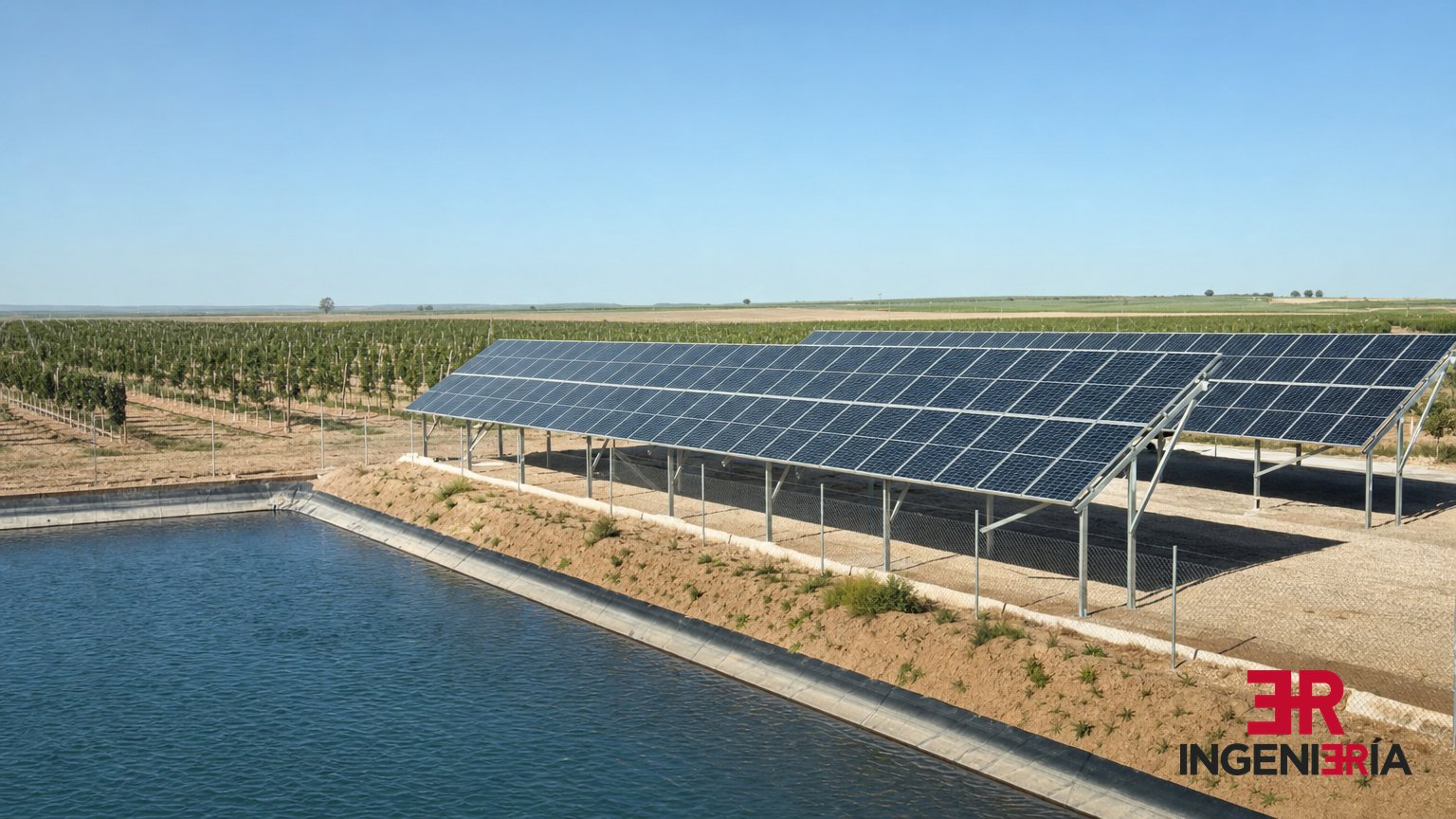
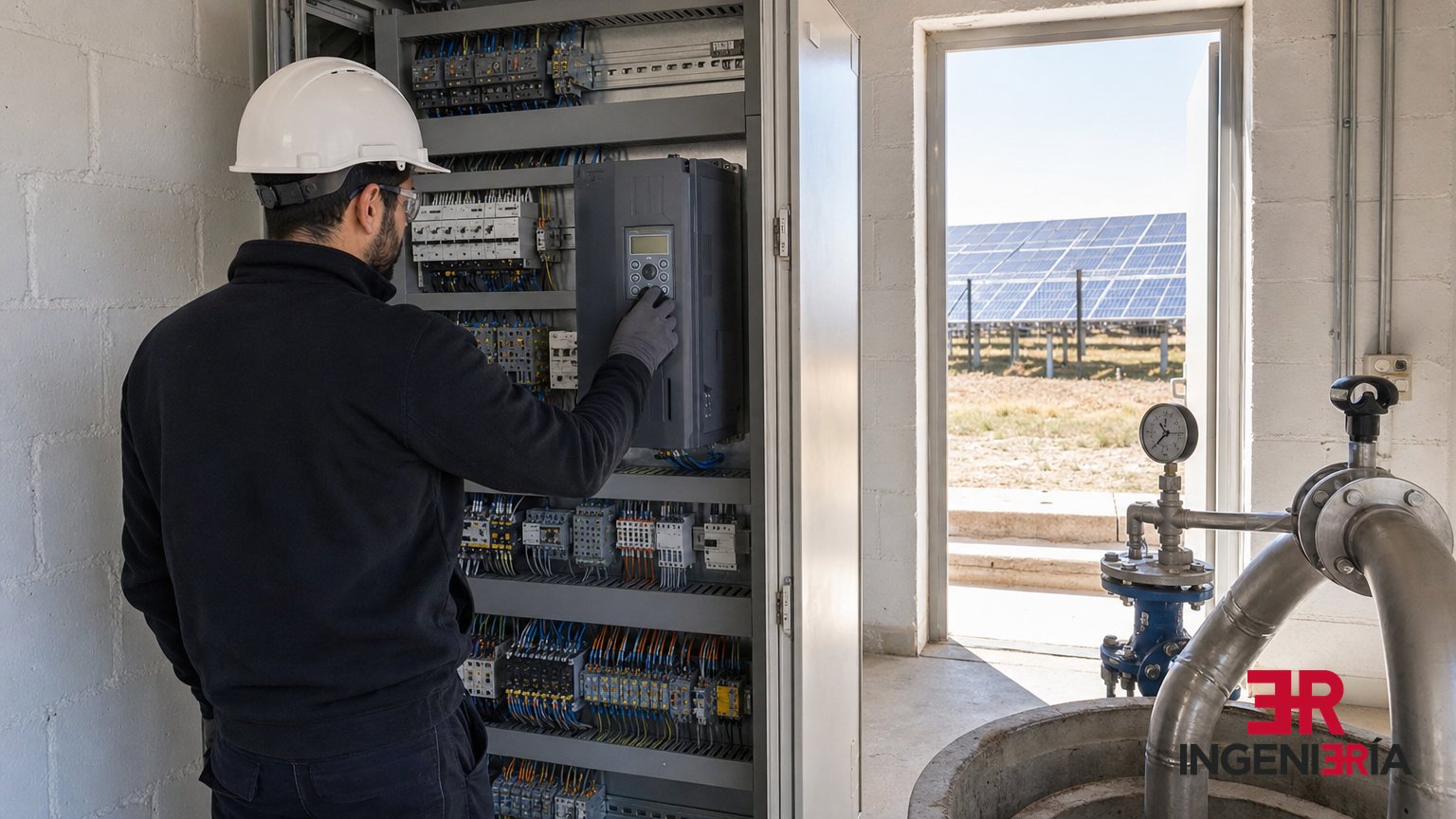
A solar pumping system has four parts. The PV array produces direct current. The variable frequency drive (or converter) transforms it and adjusts the pump speed to the irradiance at any given moment: if a cloud passes and irradiance drops slightly, the pump runs slower instead of stopping dead; below a threshold, it stops. The pump, either submersible in a well or surface-mounted, moves the water. And the control system decides when to start, which sector to irrigate and what to do if there is not enough sun or there is too much water.
The component most often forgotten is storage. In agricultural irrigation, kilowatts are almost never stored in batteries: water is stored. A reservoir or an elevated tank lets you pump during the sunny hours and irrigate later, at whatever time the crop needs. That is why on many farms the reservoir is what makes a solar pumping system work.
Off-grid PV pumping systems have their own international standard for qualification and performance measurement, IEC 62253, which covers the motor-pump set connected to the array directly or through a converter [1]. It is the reference to ask for when comparing equipment.
Off-grid or grid-connected solar pumping: the legal difference
The dividing line is set by Real Decreto 244/2019, which regulates self-consumption. An off-grid installation is one in which “there is at no time any physical capacity for electrical connection to the grid”, and the decree adds that installations disconnected from the grid by switches or equivalent devices are not considered off-grid [2]. Off-grid installations fall outside its scope.
In practice, a pumping system whose panel and utility connection are joined by a changeover switch, even if it never feeds into the grid, is not off-grid. It is self-consumption, and is processed as such. When the installation is grid-connected, the decree distinguishes two modalities: without surplus, which requires an anti-export mechanism that prevents energy being fed into the grid, and with surplus, which allows it to be exported [2].
| Configuration | When it makes sense | Legal fit | What to watch |
|---|---|---|---|
| Off-grid, direct pumping to reservoir | Farm with no nearby power line; irrigation that allows flexible hours | Outside RD 244/2019 [2]; low voltage installation | The reservoir must cover the cloudy days of the highest-demand month |
| Off-grid with backup generator | No grid and a crop that cannot go days without irrigation | Outside RD 244/2019 [2] | Engine hours and diesel that continue to be consumed |
| Grid-connected, without surplus | Farm with a grid supply that wants to cut its bill without selling energy | Self-consumption without surplus, with anti-export [2] | What happens to production in the months without irrigation |
| Grid-connected, with surplus | Solar output put to use outside the irrigation season (sheds, cold storage, winery) | Self-consumption with surplus [2] | Longer permitting process and a compensation or sale contract |
If the farm already has other loads, the solar pumping system is designed together with them. It is the same work we do in our self-consumption installations, with the pump as the main load.
Which tariff hour the sun competes with
If the farm has a grid connection, the solar kilowatt hour does not compete with “electricity” in general: it competes with the price of the period in which you would have irrigated without panels. And under the access tolls of the Spanish electricity tariff, from Monday to Friday, the sunny hours almost never fall in the cheapest period.
CNMC Circular 3/2020 divides the year into seasons and the day into six periods for supplies above 15 kW, which pay the 3.0TD or 6.1TD tolls [3]. From Monday to Friday, 00:00 to 08:00 is always P6, the cheapest period, and Saturdays, Sundays and national public holidays are P6 all day [3]. This is how the irrigation-season months look on the mainland:
| Months (mainland) | Season | 09:00 to 14:00 | 14:00 to 18:00 | 18:00 to 22:00 | 00:00 to 08:00 and weekends |
|---|---|---|---|---|---|
| April, May, October | Low | P4 | P5 | P4 | P6 |
| June, August, September | Medium | P3 | P4 | P3 | P6 |
| July | High | P1 | P2 | P1 | P6 |
Access toll periods on non-holiday weekdays (Monday to Friday) according to CNMC Circular 3/2020 [3]. From 08:00 to 09:00 and from 22:00 to 00:00 the same period applies as from 14:00 to 18:00. The final price of each period also depends on each farm's energy contract.
Read against the irrigation calendar, the table says two things. The first: in July, the highest-demand month for many crops, 09:00 to 14:00 and 18:00 to 22:00 is P1, and 14:00 to 18:00 is P2, the two most expensive toll periods of the year. That is where solar pumping saves the most. The second: anyone who irrigates at night or at weekends today is already in P6, and for them the solar saving is compared against the cheapest hour. In that case, moving irrigation to the daytime only pays off if the crop and the reservoir allow it.
That is why we do not give a generic savings figure: it comes from crossing each farm's real irrigation hours with its periods. The law also provides that the access contract for irrigation may have two different contracted capacities over 12 months, “under the terms to be determined by regulation” [4]. Before sizing the contracted capacity, it is worth confirming with your energy supplier which option is currently available.
How a solar pumping system is sized
The order matters. If you start with the kilowatts, the installation ends up large in April and too small in July. You start with the water:
- Water requirement of the most demanding month, in cubic metres per day, according to crop, area and irrigation system.
- Total dynamic head: depth of the well's dynamic level, elevation difference to the reservoir or plot, pipe friction losses and the pressure the irrigation system requires.
- Flow rate and pump: with the two previous figures and the useful sun hours, the solar pump is chosen from its performance curve, not its rated power.
- Solar array: it is calculated using the irradiation at the site. The PVGIS tool from the European Commission's Joint Research Centre has a specific module for off-grid systems [5].
- Storage: the reservoir or tank volume that covers the hours without sun and the cloudy days.
The irrigation system matters too. According to the latest ESYRCE survey by the Ministry of Agriculture, in 2025 localised irrigation covered 2,181,494 hectares, 58.47% of the irrigated area in Spain, ahead of gravity, sprinkler and self-propelled systems [6]. Drip irrigation needs stable pressure in the pipe. The drive maintains it as long as there is enough power; so that a passing cloud does not leave sectors with low pressure, you also need a reservoir, an elevated tank or grid backup.
Water rights before panels
A solar pumping system does not legalise the water it draws. The Water Act allows the use, on a property, of water from springs located within it or groundwater “when the total annual volume does not exceed 7,000 cubic metres”, and in aquifers declared overexploited, or at risk of being so, it requires authorisation for new works even in that case [7]. Any other private use requires an administrative concession from the river basin authority [7].
That limit is low for a professional irrigated farm, so it is usual for the farm to need a concession. We review this at the start: designing the pumping system for a flow greater than the one granted means designing an installation that cannot be used in full.
What we ask for before designing: the concession document or registration of the water use, with the authorised annual volume; well data (depth, static and dynamic level, test flow rate); a plan of the plots and irrigation sectors, and the electricity bills for a full irrigation season if there is a grid supply.
Grants for solar irrigation pumping
The state self-consumption incentives programme under Real Decreto 477/2021 was in force until 31 December 2023 [8]. As of September 2026 we have not found an open state call for solar irrigation on individual farms, so it is worth checking the regional ones case by case.
Public funding has reached irrigation communities. A nearby example: in March 2025 the Ministry of Agriculture handed over to the Balazote-La Herrera Irrigation Community, in Albacete, a floating PV plant for its irrigation system, with an investment of €3,052,588 and public funding of up to 80% of eligible costs, using Recovery Plan funds. It serves 445 farmers and 5,580 hectares in Balazote, La Herrera and Lezuza [9].
How we do it at ER Ingeniería
We carry out solar pumping from start to finish: study of the water and consumption, design, legalisation of the installation, execution and support after commissioning. For control we have SuitER Solar Irrigation, the mobile app of our SuitER industrial software, which schedules irrigation according to the electricity tariff time period and the available solar power. If the project grows to plant scale, we handle it as a solar farm.
Shall we study your solar pumping system?
Tell us what you grow, where you get your water and at what hours you irrigate. With that information we will tell you which configuration fits and what installation is needed. What we design and build, and how it is controlled from your mobile, is on our service pages.
See our solar irrigation installations SuitER Solar Irrigation Talk to our teamOr call us on 967 140 850
Frequently asked questions about solar pumping for irrigation
What is solar pumping?
It is a system that moves irrigation water using electricity from PV panels. The solar array powers the pump through a variable frequency drive, and the water goes straight to the irrigation network or to a reservoir to irrigate later. It can work off-grid or combined with the grid.
How is a solar pumping system for irrigation sized?
You start with the water, not the panels: daily requirement in the month of highest demand, total dynamic head (well depth, elevation differences, losses and irrigation pressure) and possible irrigation hours. With that, the pump is chosen from its performance curve, the solar array is calculated using the irradiation at the site (for example, with the European Commission's PVGIS) and the reservoir or tank is sized.
Does a solar irrigation pump need batteries?
In agricultural irrigation, almost never. The usual approach is to store water instead of electricity: you pump into a reservoir or tank during the sunny hours and irrigate later, at whatever time the crop needs.
Does a solar pumping system with a grid changeover switch count as an off-grid installation?
No. Real Decreto 244/2019 defines an off-grid installation as one with no physical capacity for connection to the grid, and clarifies that those disconnected by switches or equivalent devices are not considered off-grid. If there is a changeover switch, it is self-consumption and is processed as such.
At which hours does a grid-connected solar pumping system save the most?
In the hours with the most expensive toll. On the mainland, in July and from Monday to Friday, 09:00 to 14:00 and 18:00 to 22:00 is P1, and 14:00 to 18:00 is P2, according to CNMC Circular 3/2020. Anyone who already irrigates at night or at weekends is in P6, the cheapest period, and there the solar saving is smaller.
What happens to solar production outside the irrigation season?
It depends on the configuration. In an off-grid pumping system, the energy the pump does not use is lost. Grid-connected without surplus, the anti-export device prevents it being fed into the grid, so it is only used if the farm has other loads. With surplus it can be exported to the grid, with a longer permitting process and a compensation or sale contract.
How much water can be pumped from a well without a concession?
The Water Act allows the use, on a property, of groundwater or water from springs located within it when the total annual volume does not exceed 7,000 cubic metres. In aquifers declared overexploited, or at risk of being so, new works need authorisation even in that case. Above that volume, a concession from the river basin authority is required.
Are there grants for installing solar pumping?
The state self-consumption incentives programme under RD 477/2021 was in force until 31 December 2023. As of September 2026 we have not found an open state call for individual farms; irrigation communities have received Recovery Plan funding for PV irrigation plants.
Sources
- International Electrotechnical Commission. (2011). IEC 62253:2011 Photovoltaic pumping systems: Design qualification and performance measurements. https://webstore.iec.ch/en/publication/6636
- Real Decreto 244/2019, de 5 de abril, por el que se regulan las condiciones administrativas, técnicas y económicas del autoconsumo de energía eléctrica. Boletín Oficial del Estado, 83. https://www.boe.es/buscar/act.php?id=BOE-A-2019-5089
- Circular 3/2020, de 15 de enero, de la Comisión Nacional de los Mercados y la Competencia, por la que se establece la metodología para el cálculo de los peajes de transporte y distribución de electricidad (art. 7). Boletín Oficial del Estado, 21. https://www.boe.es/buscar/act.php?id=BOE-A-2020-1066
- Ley 1/2018, de 6 de marzo, por la que se adoptan medidas urgentes para paliar los efectos producidos por la sequía en determinadas cuencas hidrográficas. Boletín Oficial del Estado, 57. https://www.boe.es/buscar/doc.php?id=BOE-A-2018-3171
- Joint Research Centre, European Commission. (n.d.). Photovoltaic Geographical Information System (PVGIS). https://re.jrc.ec.europa.eu/pvg_tools/en/
- Ministerio de Agricultura, Pesca y Alimentación. (2025). Análisis de los regadíos españoles 2025. Encuesta sobre Superficies y Rendimientos de Cultivos (ESYRCE). https://www.mapa.gob.es (PDF)
- Real Decreto Legislativo 1/2001, de 20 de julio, por el que se aprueba el texto refundido de la Ley de Aguas (arts. 54 y 59). Boletín Oficial del Estado, 176. https://www.boe.es/buscar/act.php?id=BOE-A-2001-14276
- Instituto para la Diversificación y Ahorro de la Energía. (n.d.). Incentivos autoconsumo y almacenamiento con fuentes de energías renovables (RD 477/2021). https://www.idae.es/ayudas-y-financiacion/para-energias-renovables-en-autoconsumo-almacenamiento-y-termicas-sector/incentivos-autoconsumo-y-almacenamiento-con-fuentes-de-energias-renovables-rd-4772021
- Ministerio de Agricultura, Pesca y Alimentación. (2025, 20 March). El Ministerio de Agricultura, Pesca y Alimentación entrega a la Comunidad de Regantes de Balazote-La Herrera (Albacete) una planta solar fotovoltaica flotante. https://www.mapa.gob.es