
Solar farm construction in Spain: phases, permits and timelines
Renewable energy · EPC
In the construction of solar farms (or solar PV plants) in Spain, the administrative calendar rules, not the construction one. Royal Decree-Law 23/2020 grants 37 months to obtain the administrative construction authorisation and five years for the definitive operating authorisation, counted from the moment the access permit is obtained. Missing either of those milestones makes the permits lapse automatically and the financial guarantees deposited are called in [1].
At ER Ingeniería we have been in the electrical sector since 1981 and we carry out the complete cycle on an EPC basis: design, engineering, procurement and construction. More than 2.8 GWp designed and permitted, more than 400 MW built in solar PV generation plants, and a management system based on the ISO 9001 and ISO 14001 standards. What is explained on this page is exactly the service we provide, which is why we wrote it with deadlines and standards up front rather than adjectives.
The short version: the critical path in solar farm construction is administrative. The milestones of RD-ley 23/2020 lapse on their own and take the guarantees with them. Construction is the part of the schedule you can actually act on, and you act on it with machinery and method, not with more people.
On this page
- What an EPC contract for a solar farm includes
- The seven phases of building a solar farm
- The administrative milestones that lapse on their own
- When an environmental impact assessment is required
- Installation: why pile driving determines the construction schedule
- Commissioning, monitoring and operation
- How we work at ER Ingeniería
What an EPC contract for a solar farm includes

EPC stands for Engineering, Procurement and Construction: a single point of contact is responsible for engineering, equipment purchasing and execution, at a fixed price and schedule. The alternative is to split the project up and have the developer take on the coordination and the gaps between contracts.
The difference lies in how responsibility is shared. When pile driving meets a substrate different from the one in the geotechnical study, a split contract opens a dispute over who pays for the redesign of the structure. Under an EPC, it does not.
Our scope extends up to the RTB status (Ready to Build: a project with all permits final, ready to start construction) and from there covers construction engineering for generation, evacuation and the substation, construction, and the site engineering supervision. We also audit solar PV plants that have already been built: PPI verification, string V-I curves and tests on generating elements.
The seven phases of building a solar farm

In our experience, solar PV plants go through the same seven phases. What changes from one project to another is how much each one gets stuck.
| Phase | What is resolved | What blocks it in practice |
|---|---|---|
| 1. Feasibility and access point | Solar resource, land, evacuation capacity and access and connection permit | Without capacity at the node there is no project, however good the plot is |
| 2. Basic engineering | Peak power, mounting structure technology, evacuation route and preliminary design | A change of layout forces the environmental documentation to be redone |
| 3. Environmental processing | Environmental impact assessment, ordinary or simplified | It is the longest milestone: 31 months maximum [1] |
| 4. Administrative authorisations | Prior authorisation, construction authorisation and, where applicable, declaration of public utility | Public consultation, objections and separate documents for the affected administrations |
| 5. Construction engineering and procurement | Execution project, geotechnical study and orders for modules, structure and inverters | Lead times for transformers and medium-voltage switchgear |
| 6. Construction | Earthworks, pile driving, structure, modules, cabling, transformer stations and substation | Actual geotechnics different from those expected, and weather |
| 7. Testing and commissioning | Tests, commissioning certificate and operating authorisation | Coordination with the grid operator for the first synchronisation |
Construction is not short either. As a public and verifiable reference: ACCIONA Energía’s 50 MWp “Planta Fotovoltaica Bolarque” in Villalba del Rey (Cuenca), with more than 92,568 modules of 540 W, began construction in November 2021 and came into operation in December 2023 [6]. Two years of construction, after the years of permitting.
Phases 1 to 4 use up the calendar. Phases 5 to 7 are the ones contracted to an EPC.
The administrative milestones that lapse on their own

This is the part almost nobody explains and the one that decides whether a project goes ahead. RD-ley 23/2020 was born of a bottleneck: its preamble puts accumulated access requests at 430,000 MW, more than four times the 105,000 MW installed in Spain at the end of 2018 [1]. The response was a sequence of milestones with maximum deadlines which, for permits granted since it came into force, count from the date the access permit is obtained [1].
| Milestone | Maximum deadline |
|---|---|
| Application for the connection permit | 6 months |
| Application for prior administrative authorisation submitted and admitted | 6 months |
| Obtaining the favourable environmental impact statement | 31 months |
| Obtaining the prior administrative authorisation | 34 months |
| Obtaining the administrative construction authorisation | 37 months |
| Obtaining the definitive administrative operating authorisation | 5 years |
Deadlines under article 1.1.b) of RD-ley 23/2020 in its current wording, applicable to access permits granted after it came into force [1]. Earlier permits have their own calendar in section a) of the same article. Article 1 is cited in its consolidated wording, most recently amended by final provision 11 of Real Decreto-ley 7/2026 of 20 March, in force since 22 March 2026; checked against the consolidated BOE text on 7 September 2026.
The consequence of missing a milestone is not an extension: it is the automatic lapse of the access permit and the immediate call on the financial guarantees deposited to process the application, under articles 59 bis and 66 bis of RD 1955/2000 [1][4]. There is one important nuance: if the environmental impact statement does not end up favourable for reasons not attributable to the developer, the guarantees are not called, but the permit lapses all the same. The only route that really stops the clock is the precautionary measure in section 1 bis of article 1 of RD-ley 23/2020 itself: if the developer proves that an administrative or contentious-administrative appeal has suspended the effect of the authorisations, the counting of deadlines is paused until it is lifted [1].
Article 23 of RD 1183/2020 sets that guarantee at €40/kW installed, that is €40,000 per MW, deposited before applying for access and not recoverable until the definitive operating authorisation [7]. A 50 MW project has two million euros tied up while the milestones run.
The prior, construction and operating administrative authorisations are those regulated by Ley 24/2013 on the Electricity Sector [3]. When the evacuation route needs to occupy third-party land, the declaration of public utility is added, which goes through public consultation.
Who authorises: the 50 MW threshold
The authority changes depending on capacity. Ley 24/2013 reserves to the General State Administration the “mainland electricity generation installations, including their evacuation infrastructure, with installed electrical capacity above 50 MW” [3]. Below that threshold, and if the project does not leave the territory of a single autonomous community, the autonomous community authorises.
The body, the procedure and the timescales change. Splitting the project into two plants of under 50 MW or presenting it as one is decided at basic engineering and shapes the following three years.
What happens when a milestone is missed: Almansa 1
The “Almansa 1” solar PV plant, of 75.60 MW between Albacete and Valencia, was processing its authorisations before the Directorate-General for Energy Policy and Mines. On 7 September 2024 Red Eléctrica de España notified the Ministry of “the lapse of the access and connection permits granted pursuant to Real Decreto-ley 23/2020”. The file ended with the resolution of 15 October 2025, published in the BOE of 6 November, accepting the developer’s withdrawal [8].
It is a 75 MW project in our province, with the engineering done, that was closed because a deadline ran out.
How long the paperwork takes, with dates
The “Bolarque 2” solar plant, of 50 MW in Almonacid de Zorita, Yebra and Zorita de los Canes (Guadalajara), is processing file 2020PROD046. The Guadalajara Provincial Sustainable Development Office signed its public consultation notice on 20 February 2024. It was published in the BOE of 6 March, with 30 days for objections [2].
The file number starts with 2020: nearly four years passed between opening it and publishing that notice, and construction was still to come. That is the order of magnitude to bring to the business plan.
When an environmental impact assessment is required

The threshold is not one of capacity, but of area occupied. Ley 21/2013 on environmental assessment sets it as follows for solar installations that are not roof-mounted [5]:
- Ordinary assessment if they occupy more than 100 ha (annex I, group 3.j).
- Ordinary assessment if they occupy more than 10 ha and are developed in protected Natura 2000 network areas, protected natural areas, Ramsar wetlands or core zones of Biosphere Reserves (annex I, group 9, section 20).
- Simplified assessment for all other solar installations not included in annex I (annex II, group 4.j).
That is why the layout is not just a production matter: the difference between 98 and 102 hectares occupied can be the difference between a simplified and an ordinary assessment, and with it months of permitting. It is decided in phase 2 and paid for in phase 3.
Installation: why pile driving determines the construction schedule

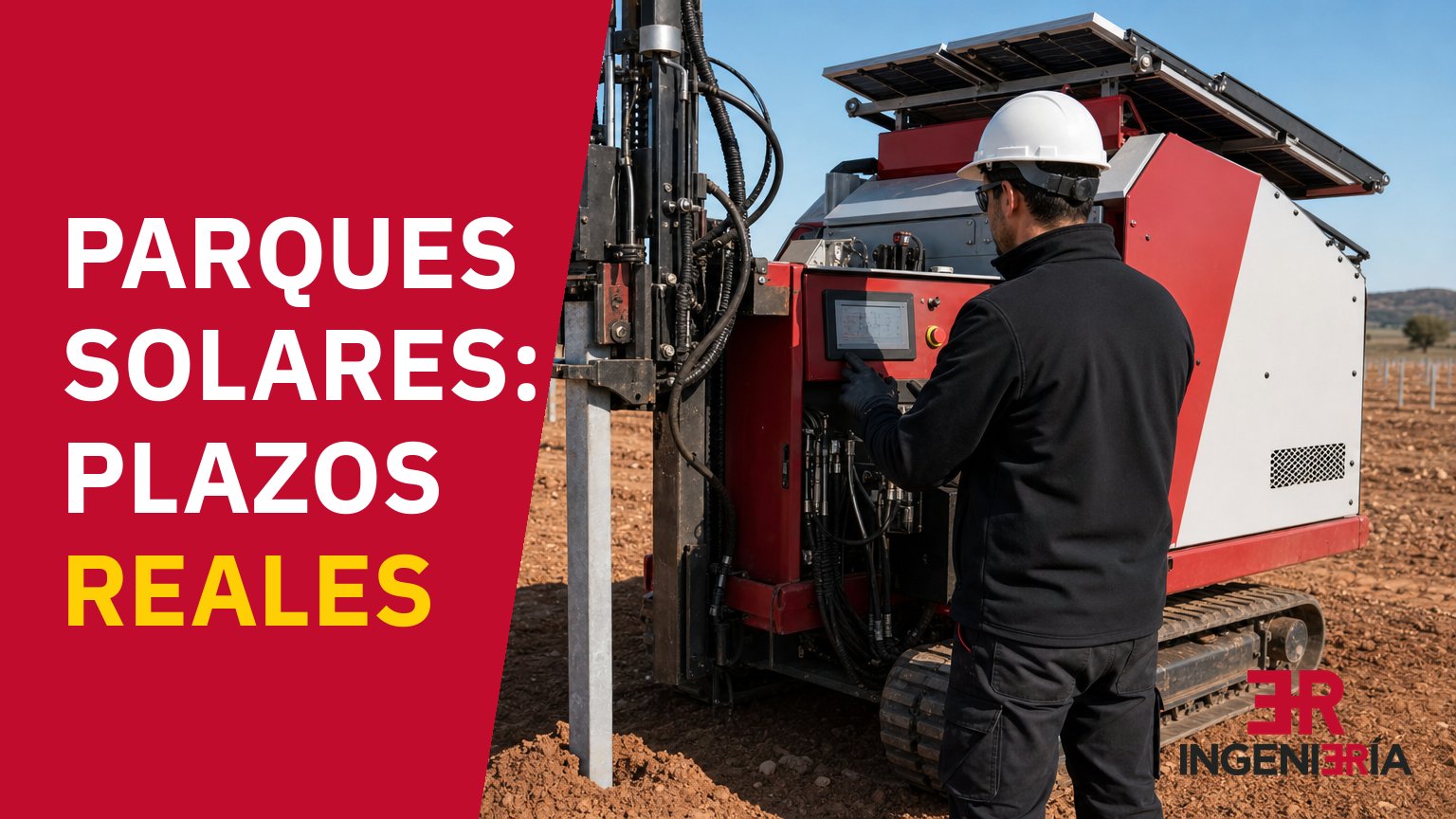
When construction can finally begin, the clock is set by the foundations. A solar PV plant of tens of megawatts needs tens of thousands of posts driven into the ground, and the structure, modules and cabling follow behind that crew.
Pile driving versus concrete
A concrete footing means waiting for it to cure, moves concrete mixers along site tracks and leaves something that later has to be demolished. Driving the profile directly eliminates all three. We were among the first in Spain to do without concrete: “El Quintillo”, at 52.5 MWp, was the first plant we designed with pile-driven mounting, and before it “Casa del Ángel” (12 MWp) was the first with strings bus using weatherproof branch connectors, which eliminate the string boxes. Today both solutions are standard in the sector.
Pile driving does, however, require a serious geotechnical study and pull-out tests on the ground itself before fixing the profile and embedment depth. A substrate with refusal forces predrilling or a change of profile, and that is where weeks are lost. When the geotechnical work is done late or on the cheap, you pay for it on site.
And one thing should be said plainly: in our experience there is no UNE standard that sets a standard procedure for pull-out testing of driven profiles in solar PV plants. The standardisation that does exist covers the solar tracker (UNE-EN 62817, adoption of IEC 62817), not driving the profile into the ground. What exists are manufacturer specifications and the designer’s judgement, so how many tests are done and where is decided by each company. It is worth asking whoever quotes for the works.
Our e-SAP machines
We build our pile drivers in our 1,150 m² mechanical workshop in Villarrobledo. We call them e-SAP (Autonomous Power System): they run only on solar energy and batteries, with no diesel: they eliminate their own direct CO₂ emissions and daily refuelling on site, although the rest of the installation (transport, auxiliary machinery, steel) still has its own footprint. They are designed for in-line installation, advancing row by row rather than through isolated work fronts.
Having the machinery in-house has a practical consequence: the pile-driving schedule does not depend on a subcontractor’s diary. The details are on the page for the e-SAP system and on the page for our self-sufficient building, where we build them.
Commissioning, monitoring and operation
Commissioning does not end with the first synchronisation, but when the plant produces what the project said it would produce. That can only be known by measuring: V-I curves per string, thermography, PPI verification and comparison against the solar resource for the period.
This is where you can tell where we come from. We have been doing industrial automation with SCADA and PLC for forty years, and that same instrumentation and control work is what we apply to the solar PV plants we build. Our SuitER software monitors processes in real time and turns data into operating decisions.
For installations that are not a generation plant but for own consumption, the approach changes completely: there we work on self-consumption installations and solar irrigation, which have their own, much lighter permitting.
How we work at ER Ingeniería
We started in 1981 with electrical engineering and low- and high-voltage installations. Between 1993 and 2005 we designed and built cogeneration plants of up to 62 MW of trigeneration. In 1996 we carried out our first off-grid solar PV installation, of 2.6 kW.
In 2007 we joined the Renovalia Group as ER Ingeniería EPC. Since then we have accumulated more than 2.8 GWp designed and permitted and more than 400 MW built, including the “Bolarque” solar PV plant, of 126 MWp, in the province of Guadalajara, where our scope was the design and complete construction of the plant and its evacuation. The location comes from our own site records. We spell it out because the name is repeated: “Bolarque 2”, cited above, is a 50 MW plant in Almonacid de Zorita, Yebra and Zorita de los Canes (Guadalajara), and ACCIONA Energía’s “Planta Fotovoltaica Bolarque” is another, of 50 MWp, in Villalba del Rey (Cuenca). Three different plants with the same name.
We work with our own team of more than 25 electrical, mechanical, electronic and computer engineers, and with our own machinery. In a sector where almost everything is subcontracted, those two things are what allow us to commit to a construction schedule and keep to it. The details are in our history and in the energy and electrical projects we carry out.
We do not promise returns or permitting timescales: they do not depend on us. What we put in writing is the scope, the budget and the schedule of what we build.
Tell us where your solar farm stands
If you have the access point granted and want to know what real timetable lies ahead, or if you are already at RTB and need an EPC that is accountable for the schedule, let’s talk. We review the documentation you have and tell you what is missing.
Contact ER IngenieríaReferences
- [1] España. (2020). Real Decreto-ley 23/2020, de 23 de junio, por el que se aprueban medidas en materia de energía y en otros ámbitos para la reactivación económica (consolidated text). Boletín Oficial del Estado, no. 175. https://www.boe.es/buscar/act.php?id=BOE-A-2020-6621
- [2] Delegación Provincial de la Consejería de Desarrollo Sostenible en Guadalajara. (2024). Anuncio para información pública del proyecto de Planta Solar FV de 50 MW «Bolarque 2» y sus infraestructuras de evacuación (BOE-B-2024-7953). Boletín Oficial del Estado, no. 58. https://www.boe.es/diario_boe/txt.php?id=BOE-B-2024-7953
- [3] España. (2013). Ley 24/2013, de 26 de diciembre, del Sector Eléctrico (consolidated text). Boletín Oficial del Estado, no. 310. https://www.boe.es/buscar/act.php?id=BOE-A-2013-13645
- [4] España. (2000). Real Decreto 1955/2000, de 1 de diciembre, por el que se regulan las actividades de transporte, distribución, comercialización, suministro y procedimientos de autorización de instalaciones de energía eléctrica (consolidated text). Boletín Oficial del Estado, no. 310. https://www.boe.es/buscar/act.php?id=BOE-A-2000-24019
- [5] España. (2013). Ley 21/2013, de 9 de diciembre, de evaluación ambiental (consolidated text, annexes I and II). Boletín Oficial del Estado, no. 296. https://www.boe.es/buscar/act.php?id=BOE-A-2013-12913
- [6] ACCIONA Energía. (n.d.). Planta Fotovoltaica Bolarque. https://www.acciona-energia.com/es/proyectos/planta-fotovoltaica-bolarque
- [7] España. (2020). Real Decreto 1183/2020, de 29 de diciembre, de acceso y conexión a las redes de transporte y distribución de energía eléctrica (consolidated text, art. 23). Boletín Oficial del Estado, no. 340. https://www.boe.es/buscar/act.php?id=BOE-A-2020-17278
- [8] Dirección General de Política Energética y Minas. (2025). Resolución de 15 de octubre de 2025, por la que se acepta el desistimiento de la solicitud de autorización administrativa previa y de construcción de la instalación fotovoltaica «Almansa 1», de 75,60 MW, en las provincias de Albacete y Valencia (BOE-A-2025-22504). Boletín Oficial del Estado, no. 267. https://www.boe.es/diario_boe/txt.php?id=BOE-A-2025-22504